Why do bond yields matter?
When an investor buys a government bond, they are effectively lending cash to that government, with the promise that their money will be returned in full at the end of the maturity period.
The investor is entitled to regular payments for the duration of the loan, with the value of those payments determined by the bond yield. The yield is inversely related to the price of the bond — so when a bond sells off, its yield moves higher.
Major price swings in government bonds matter. If government bonds prices fall – meaning yields spike – it makes it more expensive for the government to borrow cash.
Rising government bond yields can also spill over into rates on other forms of lending, making it more costly for companies and households to borrow money, ultimately impacting the wider economy.
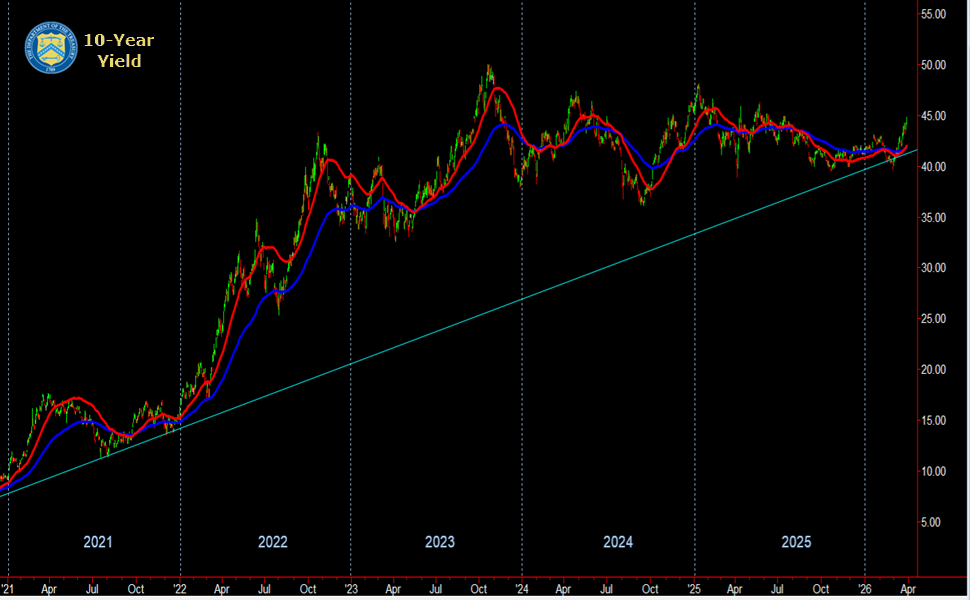
The 10-year U.S. Treasury Note
The 10-year U.S. Treasury note is a benchmark government bond that helps set prices for debt instruments all over the world, including U.S. mortgages — making it a critical asset to track for those seeking to invest.
This means that when the yield moves higher consumers are likely to have less money available to spend as mortgage repayments rise. It also means that firms will face higher costs on their debts and thus offer fewer returns for equity investors or curb expansion.
Treasury Notes (T-Notes)
U.S. government bonds are viewed as a “safe haven” by investors. As demand for government bonds increases, their price increases and the “yield” at which they pay our drops. The 10-year Treasury yield has a direct relationship to the 30-year fixed mortgage rate. So when demand for the 10-year bond is high, its yield drops, and mortgage rates feel downward pressure
T-Notes mature in two to ten years and offer a coupon or interest payment every six months. The 10 year T-Note is the Treasury most often quoted in discussions about the bond market. T-Notes are sold at auction every Week in increments of $100 and an individual can purchase up to $5 million per auction.
A debt owed by the United States government for a period of ten years. Each note has a stated interest rate, which is paid semi-annually. Because the United States is seen as a very low-risk borrower, many investors see 10-year Treasury Note interest rates as indicative of the wider bond market. Normally, the interest rate decreases with greater demand for the Notes and rises with lower demand.
For example, in December 2008, 10-year interest rates were the lowest in history due to deteriorating economic conditions and the consequent desire of investors for low-risk investments.
Bond Risks
There are risks to buying Treasury Bonds and similar debt instruments. The two major risks are inflation risk and currency risk.
Inflation risk:
Inflation risk refers to the risk that your purchasing power will fall as inflation increases. If you have a coffee can stuffed with a thousand dollars buried in your back yard, you can be pretty sure that the $1,000 will still be there when you dig it out of the ground in five years. However, the $1,000 is worth less in five years because the value of a dollar will have fallen due to inflation. The same is true for money saved in bank accounts, CDs, or anything else not pegged to inflation. If inflation is 5% a year, you lose five dollars out of every hundred dollars each and every year.
This risk is dangerous because it's difficult to see with your eyes. You still see your thousand dollars sitting there, but you forget that the jar of peanut butter you buy each month or the gallon of milk you buy each Week has gotten a little more expensive (or they shrank the jar!).
Currency risk:
Another risk you face is that the dollar loses its value against other currencies. This is important because you'll probably be buying products manufacturer or produced overseas and so your purchasing power will once against be tested. If you lock up your funds in a bond or CD, the risk that the dollar's value goes down will have an impact on your savings.
Are these two reasons enough to preclude you from putting your money into a bond (or CD or savings account)? I don't think so, but you need to be aware of them.
The 10 year T-note yield Importance:
1. It is very important because this is the yield that effects mortgage rates which is such a major part of the economic recovery.
2. Key Measure of Borrowing Costs
3. The usual yardstick for a country's borrowing costs
4. The interest rate a Country pays to borrow money
The 10 year T-bond yield is Rising:
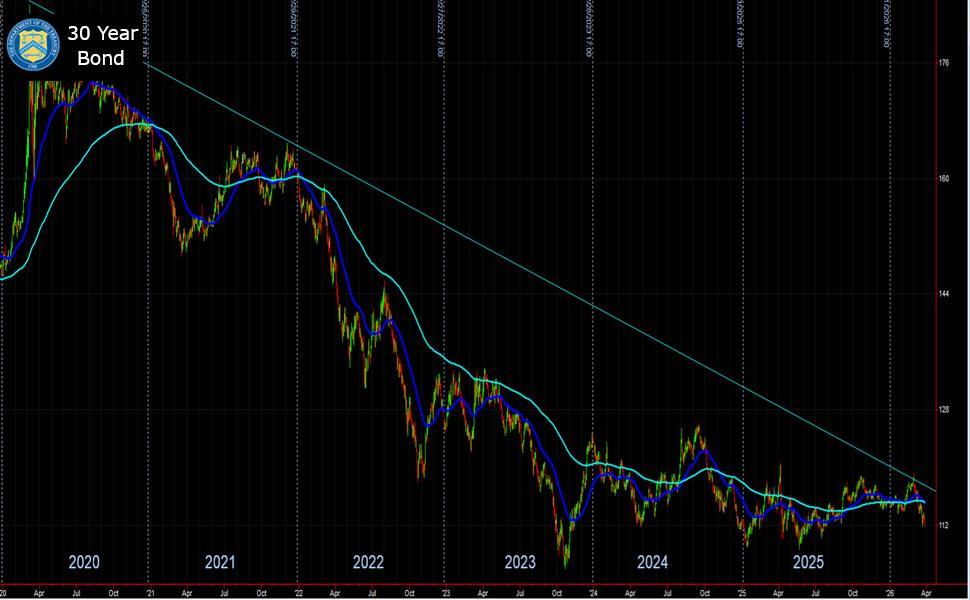
1. This move higher in the yield means that bond prices are declining lower.
2. Traders can see how TLT is selling.The IEF is trading lower.
3. Countries are forced to pay a highest borrowing costs.
4. Facing rising borrowing costs as its 'AAA' credit rating comes under threat.
5. If The interest rate a Country pays to borrow money rises; it fears that the country will lose its cherished AAA credit rating.
6. The highest a nation can have allows a Coutry to borrow money from the markets cheaply.
7. AAA rating benefit of the rating, namely low borrowing costs. credit rating also has psychological and political importance. they have to pay more interest on the sale of government debt....
8. higher yields reflect investor concern about the country's fundamentals: its overall debt load and the annual budget deficits it runs.
9. borrowing costs continue to rise as worries grow it will lose prized AAA rating
10. talian borrowing cost hits 7%Widely seen as unsustainable, the figure is the same point at which Portugal, Greece and Ireland were forced to seek a bailout,
11. If Italy were to borrow money repayable in ten years, the interest rate would be more than 7 per cent. This is a stark contrast to Germany's implied interest rate of 1.73 per cent.
12. No one wants to lend to a country when that country would use the loan to pay the interest on previous loans - that's throwing good money after bad".eflecting investors concerns that they may not get their money back
Bonds and Interest Rates
When you buy a bond you're lending money to the bond's issuer, who promises to pay you back the principal (or par value) when the loan is due (on the bond's maturity date). In the meantime, the issuer also promises to pay you periodic interest payments to compensate you for the use of your money.
If Interest Rates Rise, the price of Fixed-income instrument declines. When interest rates rise, the prices of outstanding bonds fall; when rates fall, prices rise. Though this relation might not seem obvious at first, the reasons are fairly simple. The current yields investors can get from buying U.S. Treasury securities is given by interest rates.
Take this example. Say the U.S. government sells Treasury bonds when prevailing market interest rates are 8%. So, a bond with a face value of $1,000 on issue would pay $80 a year in interest - usually in two half-yearly installments of $40. But if market interest rates were to rise to 10%, then who would want to buy such a bond? So, the market price of the bond would have to fall to a level where that fixed $80 annual payment were the equivalent of a 10% annual yield - in this case, the price would have to fall to $800, so that the annual $80 payment would equal 10% of the purchase price of the bond. Since bond prices are usually expressed at a percent of face (or "par") value, the price of the bond would be quoted at 80. |