Treasury Budget
The U.S. government on Monday posted a $171 billion budget deficit for August, 15% lower than the $200 billion gap a year ago, as recovery-driven tax receipts grew faster than outlays for COVID-19 pandemic relief programs, the Treasury Department said. The August deficit was $2 billion less than the average forecast by analysts in a Reuters survey. A U.S. Treasury official said the August budget results would not alter the department's estimates for when Treasury's extraordinary financing measures to avoid breaching the $28.4 trillion debt limit would be exhausted. U.S. Treasury Secretary Janet Yellen last week urged Congress to increase or suspend the debt limit, saying that "cash and extraordinary measures will be exhausted during the month of October," leaving the government unable to fully pay its obligations.
Consumer Price Index (CPI) - Inflation
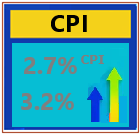
The Consumer Price Index for All Urban Consumers rose 5.3 percent for the 12 months ending August 2021, a smaller increase than the 5.4-percent rise for the year ending July. Prices for all items less food and energy rose 4.0 percent over the last 12 months, also a smaller increase than the year ending July.
Consumer prices post smaller-than-expected increase in August. Consumer prices in August rose 5.3% from a year ago and 0.3% from July, the Labor Department reported Tuesday. Both totals were slightly below market expectations, sending stock futures higher.Stripping out food and energy, the consumer price index was up just 0.1% for the month.
Philadelphia Fed Manufacturing Index
Philadelphia Fed Manufacturing Index jumps to 30.7 in September 2021 vs. 18.8 expected. Philly Fed Manufacturing Index improved decisively in September. US Dollar Index continues to push higher toward 93.00. The Federal Reserve Bank of Philadelphia reported on Thursday that the headline Manufacturing Activity Index of the Manufacturing Business Outlook Survey improved to 30.7 in September from 19.4 in August. This reading came in stronger than the market expectation of 18.8. Further details of the publication revealed that the New Orders Index declined to 15.9 from 22.8, the Employment Index edged lower to 26.3 from 32.6 and the Prices Paid Index fell to 67.3 from 71.2. Finally, the Six-month Business Conditions Index dropped to 20 from 33.7.
Retail Sales
Retail sales post surprise gain as consumers show strength despite delta fears. Retail sales rose 0.7% in August 2021 versus expectations for a 0.8% decline. Excluding autos, sales increased 1.8% versus the Dow Jones estimate for a 0.1% gain. Economists had expected that consumers cut back their activity as the delta variant continued its tear through the U.S. Persistent supply chain bottlenecks also were expected to hold back spending as in-demand goods were hard to find.
Jobless Claims
The number of Americans seeking unemployment benefits moved up last week to 332,000 from a pandemic low, a sign that worsening COVID infections may have slightly increased layoffs. Applications for jobless aid rose from 312,000 the week before, the Labor Department said Thursday. Jobless claims, which generally track the pace of layoffs, have fallen steadily for two months as many employers, struggling to fill jobs, have held onto their workers. Two weeks ago, jobless claims reached their lowest level since March 2020. The increase was small and may be temporary. The four-week average of jobless claims, which smooths out fluctuations in the weekly data, dropped for the fifth straight week to just below 336,000, the lowest since the pandemic began.
Empire State Manufacturing index
This morning, we got the latest Empire State Manufacturing Survey, which rates the relative level of general business conditions in New York state. A level above 0.0 indicates improving conditions, below indicates worsening conditions. The diffusion index for General Business Conditions at 34.3 was an increase of 16 from the previous month's 18.3.
MBA
Mortgage applications increased 0.3 percent from one week earlier, according to data from the Mortgage Bankers Association's (MBA) Weekly Mortgage Applications Survey for the week ending September 10, 2021. This week's results include an adjustment for the Labor Day holiday. The Market Composite Index, a measure of mortgage loan application volume, increased 0.3 percent on a seasonally adjusted basis from one week earlier. On an unadjusted basis, the Index decreased 10 percent compared with the previous week. The Refinance Index decreased 3 percent from the previous week and was 3 percent lower than the same week one year ago. The seasonally adjusted Purchase Index increased 8 percent from one week earlier. The unadjusted Purchase Index decreased 5 percent compared with the previous week and was 12 percent lower than the same week one year ago. "Purchase applications - after adjusting for the impact of Labor Day - increased over 7 percent last week to their highest level since April 2021. Compared to the same week last September, which was right in the middle of a significant upswing in home purchases, applications were down 11 percent - the smallest year-over-year decline in 14 weeks," said Joel Kan, MBA's Associate Vice President of Economic and Industry Forecasting. "Both conventional and government purchase applications increased, and the average loan size for a purchase application rose to $396,800. The very competitive purchase market continues to put upward pressure on sales prices."
Treasury International Capital (TIC)
The U.S. Department of the Treasury today released Treasury International Capital (TIC) data for July 2021. The next release, which will report on data for August 2021, is scheduled for October 18, 2021. The sum total in July of all net foreign acquisitions of long-term securities, short-term U.S. securities, and banking flows was a net TIC inflow of $126.0 billion. Of this, net foreign private inflows were $127.7 billion, and net foreign official outflows were $1.7 billion. Foreign residents decreased their holdings of long-term U.S. securities in July; net sales were $14.4 billion. Net sales by private foreign investors were $23.3 billion, while net purchases by foreign official institutions were $8.9 billion. U.S. residents decreased their holdings of long-term foreign securities, with net purchases of $16.4 billion. Taking into account transactions in both foreign and U.S. securities, net foreign purchases of long-term securities were $2.0 billion. After including adjustments, such as estimates of unrecorded principal payments to foreigners on U.S. asset-backed securities, overall net foreign sales of long-term securities are estimated to have been $68.0 billion in July. Foreign residents decreased their holdings of U.S. Treasury bills by $4.5 billion. Foreign resident holdings of all dollar-denominated short-term U.S. securities and other custody liabilities increased by $1.7 billion. Banks’ own net dollar-denominated liabilities to foreign residents increased by $192.3 billion.
Consumer Sentiment UM
U.S. consumer sentiment steadied in early September after plunging the month before to its lowest level in nearly a decade, but consumers continue to have a bleak view of the outlook amid a stiff bout of inflation, a survey showed on Friday. The University of Michigan said its consumer sentiment index edged up to 71 in the first half of September from 70.3 in August - the lowest since December 2011. Economists polled by Reuters had forecast a reading of 72. Assessments of current conditions slipped further, to 77.1 from 78.5 in August, while the survey's forward-looking expectations index ticked up to 67.1 from 65.1, which had been the lowest since 2013.
Industrial Production
U.S. industrial production slowed to a 0.4% gain in August as shutdowns of petroleum refineries and petrochemical plants caused by Hurricane Ida curbed manufacturing activity. Plant closures long the Gulf Coast as well as lost oil production during last month's hurricane shaved 0.3 percentage points from output, the Federal Reserve reported Wednesday. Industrial output had risen a revised 0.8% in July. Industrial production covers manufacturing, utilities and mining. For just manufacturing, factory output slowed to a tiny 0.2% gain, reflecting the hurricane impact and continuing supply chain problems. Factory output had risen a much stronger 1.6% in July. Manufacturing has been hobbled this year due to snarled supply chains, particularly at auto plants where semiconductors needed for new cars have been in short supply.
US industrial production rose 0.4% in August on a monthly basis, in line with the market estimate, according to data released by the Federal Reserve on Wednesday. Industrial production, which measures the change in the value of output produced by manufacturers and utilities, showed an increase of 0.8% in July, revised down from 0.9%.The nation's factories, mines and utilities operated at 76.4% of capacity in August, up slightly from 76.2% in July.
U.S. Import and Export Price Indexes
U.S. import prices post first decline in 10 months. U.S. import prices fell for the first time in 10 months in August amid a decline in the costs of petroleum products, further evidence that inflation had probably peaked. Import prices dropped 0.3% last month after increasing 0.4% in July, the Labor Department said on Wednesday. The first decrease since October 2020 lowered the year-on-year increase to 9.0% from 10.3% in July. The report also showed export prices climbed 0.4% in August, the smallest gain since October 2020, after shooting up 1.1% in July.
U.S. import prices fell for the first time in 10 months in August amid a decline in the costs of petroleum products, further evidence that inflation had probably peaked. Import prices dropped 0.3% last month after increasing 0.4% in July, the Labor Department said on Wednesday. The first decrease since October 2020 lowered the year-on-year increase to 9.0% from 10.3% in July. Economists polled by Reuters had forecast import prices, which exclude tariffs, climbing 0.3%.
Business Inventories
Business sales gained 0.5% in July 2021 after rising 1.6% in June. At July's sales pace, it would take 1.25 months for businesses to clear shelves, unchanged from June. Business inventories increased in line with economist estimates in the month of July, the Commerce Department revealed in a report released on Thursday. The report said business inventories rose by 0.5 percent in July after climbing by an upwardly revised 0.9 percent in June. Economists had expected business inventories to rise by 0.5 percent compared to the 0.8 percent increase originally reported for the previous month. |