10-Year Treasury Yield
The 10-year Treasury yield, which serves as a benchmark for mortgage rates and as an investor confidence barometer, on Tuesday surged to its highest level since 2007. The 10-year Treasury yield was last up about 8 basis points to 4.758%. The 30-year Treasury yield rose as high 4.874%, also the highest since 2007. The 2-year Treasury yield, which is sensitive to expectations around where the Federal Reserve will set its own key borrowing rate, increased slightly to 5.129%.
10-year Treasury note yield — key to mortgage rates — surges to 16-year high The 10-year Treasury note yield — key to the housing market via its influence on mortgage rates — climbed to 4.745% early Tuesday, the highest since Aug. 15, 2007. The 30-year bond yield touched 4.862%, its highest yield since May, 2009 (when it traded above 5%). The worry is that the escalating federal budget deficit will create more supply of bonds than demand can meet, requiring higher yields to clear the market;
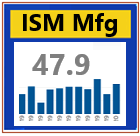
ISM Manufacturing Index US manufacturing sector nears recovery; construction spending solid. The Manufacturing PMI registered 49 percent in September, 1.4 percentage points higher than the 47.6 percent recorded in August. The overall economy expanded weakly after nine months of contraction following a 30-month period of expansion. (A Manufacturing PMI above 48.7 percent, over a period of time, generally indicates an expansion of the overall economy.) The ISM said that its manufacturing PMI increased to 49.0 last month, the highest reading since November 2022, from 47.6 in August. Still, September marked the 11th straight month that the PMI remained below 50, which indicates contraction in manufacturing. That is the longest such stretch since the 2007-2009 Great Recession. Economists polled by Reuters had forecast the index edging up to 47.7. Last month's rise pulled the PMI above the 48.7 level that the ISM says over time indicates an expansion of the overall economy. Growth estimates for the third quarter are as high as a 4.9% annualized rate. The economy grew at a 2.1% pace in the April-June quarter.
JOLTS
August job openings top 9.6 million, more than expected as labor market remains strong. Employment vacancies at U.S. businesses unexpectedly surged in August, a sign that the labor market remains tight and robust despite the Federal Reserve’s efforts to slow the economy. nJob openings totaled 9.61 million for the month, a jump of nearly 700,000 from July and well above the Dow Jones estimate for 8.8 million, the Labor Department said Tuesday in its monthly Job Openings and Labor Turnover Survey. Hires, however, rose only modestly, moving up to 5.857 million, an increase of just 35,000. bMuch of the increase in openings came in professional and business services, which showed a burst of 509,000. Openings had been on the decline for the last several months, indicating that the central bank’s interest rates hikes were beginning to have an impact on a labor market that had been hit by a large supply-demand mismatch in which openings had outnumbered available workers 2 to 1. The ratio now is down to 1.5 to 1, following an increase of workers classified as unemployed in August. The Fed follows the JOLTS report closely for signs of labor slack.
Construction Spending
Construction spending for August is expected to rise 0.5 percent following July's 0.7 percent increase that once again showed sharp residential gains versus flat nonresidential results. US construction spending rises 0.5% in August. Figure up 7.4% on annual basis, Commerce Department data shows US construction spending rose 0.5% to $1,983.5 billion in August, according to the Commerce Department figures released Monday. Construction spending, one of the major indicators of well-being in the construction sector, came in line with the market expectations. The figure for July was revised up to a monthly gain of 0.9%, from 0.7%, for $1,973.7 billion, the data showed. Annually, the reading in August was 7.4% above the figure from the same month last year, when it stood at $1,847.3 billion, the Commerce Department said. Construction spending, during the first eight months of this year, amounted to $1,284.7 billion, which is 4.2% above the $1,233.4 billion for the same period in 2022, it noted.
MBA Purchase Applications
nnnnn
Jobless Claims
Joblmmmmm
PMI Composite Final
The S&P Global US Composite PMI stood at 50.2 in September 2023, slightly up from the preliminary estimate of 50.1, indicating broadly unchanged business activity across the private sector for the second consecutive month. The service sector's output stagnated, while manufacturing production returned to growth, although the expansion was modest. New orders saw a sharp decline, and backlogs of work fell at a faster rate, while employment continued to rise at the quickest pace since June. On the price front, input costs and output charges increased at faster rates than in August, driven by rising material and transportation costs due to higher oil prices. Finally, firms were more optimistic in their expectations for output over the coming year in September, largely influenced by an uptick in confidence among manufacturing firms.
Employment
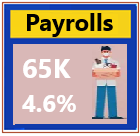
Payrolls soared by 336,000 in September, defying expectations for a hiring slowdown. Nonfarm payrolls increased by 336,000 for the month, better than the Dow Jones consensus estimate for 170,000. Average hourly earnings rose 0.2% for the month and 4.2% from a year ago, compared to respective estimates for 0.3% and 4.3%. The unemployment rate was 3.8%, compared to the forecast for 3.7%. Leisure and hospitality led job growth, followed by government and health care.
nnnn
U.Smmmmmm
nnnn
U.S. lemmmmm
nnnn
nnn
Mortgage Rates
nnnnn
|