10-Year Treasury Yield
U.S. Treasury yields declined on Tuesday as investors awaited fresh comments on the outlook for the economy and monetary policy from Federal Reserve Chairman Jerome Powell. The yield on the 10-year Treasury was down over 4 basis points to 3.938%. The 2-year Treasury was trading at 4.872% after falling about 2 basis points. Yields and prices have an inverted relationship. One basis point equals 0.01%.
Factory Orders
US factory orders down 1.6% in January. New orders for manufactured goods in the United States stood at $542.8 billion in January 2023, representing a decrease of 1.6% on a monthly basis, the US Census Bureau announced in a full report on Monday. Shipments were $100 million lower month-on-month and landed at $277.4 billion, while unfilled orders grew by $300 million to $1.16 trillion. Inventories amounted to $493.3 billion following a 0.1% decline in January 2023. The inventories-to-shipments ratio was 1.48, down compared to 1.49 from the previous month.
Whole Sale Inventories
mmm
Consumer Credit
mmmm
MBA Purchase Applications
After dropping to a 28-year low the previous week, mortgage demand recovered slightly, even though interest rates marched higher.Total mortgage application volume rose 7.4% last week, according to the Mortgage Bankers Association’s seasonally adjusted index. This happened even as the average contract interest rate for 30-year fixed-rate mortgages with conforming loan balances ($726,200 or less) increased to 6.79% from 6.71%, with points rising to 0.80 from 0.77 (including the origination fee) for loans with a 20% down payment. That is the highest level since November 2022 and 270 basis points higher than a year ago. Applications to refinance a home loan jumped 9% week to week but were 76% lower than the same week one year ago. At last week’s rate, there were barely 200,000 borrowers who could get monthly savings from a refinance, compared with well over 2 million who could have benefited at the rate one year ago, according to calculations from Black Knight, a mortgage data and analytics firm. Mortgage applications to purchase a home rose 7% for the week and were 42% lower than the same week one year ago. There is more inventory on the market now compared with a year ago, but new listings are still weak, suggesting that what is for sale isn’t selling very quickly.
ADP
Private payrolls rose by 242,000 in February, better than expected, ADP says. Private payrolls in February increased by 242,000 versus the estimate for 205,000 and above the 119,000 in January, ADP reported Wednesday. Leisure and hospitality led job growth with 83,000 additions. Financial activities added 62,000 while manufacturing showed a 43,000 gain. The ADP report comes two days before the government’s nonfarm payrolls count, which is expected to show a gain of 225,000. Private payrolls increased by 242,000 for the month, ahead of the Dow Jones estimate for 205,000 and well above the upwardly revised 119,000 jobs gain, from 106,000, in January.The ADP report serves as a precursor to the more closely followed nonfarm payrolls report the Labor Department will release Friday. Though ADP last year entered into a new partnership with Stanford University, the two counts still have differed by large margins in some cases. For instance, the Labor Department estimated payrolls rose 517,000 in January, more than four times what ADP reported. Friday’s report is expected to show growth of 225,000 in February, with the unemployment rate holding steady at 3.4%, according to Dow Jones estimates.
International Trade in Goods and Services
mmmmm
JOLTS
mmm
Beige Book
Overall economic activity increased slightly in early 2023. Six Districts reported little or no change in economic activity since the last report, while six indicated economic activity expanded at a modest pace. Labor market conditions remained solid. Employment continued to increase at a modest to moderate pace in most Districts despite hiring freezes by some firms and scattered reports of layoffs. Inflationary pressures remained widespread, though price increases moderated in many Districts.
Jobless Claims
US weekly jobless claims post largest rise in 5 months; labor market still tight. Weekly jobless claims increase 21,000 to 211,000. Four-week average of claims rises 4,000 to 197,000. Continuing claims jump 69,000 to 1.718 million. The number of Americans filing new claims for unemployment benefits increased by the most in five months last week, but the underlying trend remained consistent with a tight labor market. Part of the larger-than-expected rise in claims reported by the Labor Department on Thursday reflected a surge in applications in New York state, which some economists attributed to a mid-winter school recess from Feb. 20-24. There was also a sharp rise in filings in California. Initial claims for state unemployment benefits rose 21,000 to a seasonally adjusted 211,000 for the week ended March 4. That was the largest increase since October and lifted claims to a two-month high. Still, claims remained well below the 300,000 level, which is associated with a recession. Economists polled by Reuters had forecast 195,000 claims for the latest week. The four-week moving average for new claims, a better measure of labor market trends as it irons out weekly fluctuations, climbed 4,000 to 197,000 last week.
Employment Situation
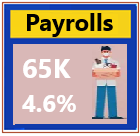
Payrolls rose 311,000 in February, more than expected, showing solid growth. Nonfarm payrolls rose by 311,000 in February, above the 225,000 Dow Jones estimate. The unemployment rate increased to 3.6%, above expectations. Average hourly earnings increased 4.6% from a year ago, less than expected, in a positive sign for inflation. Leisure and hospitality, retail and government led job creation by sector. Job creation decelerated in February but was still stronger than expected despite the Federal Reserve’s efforts to slow the economy and bring down inflation. Nonfarm payrolls rose by 311,000 for the month, the Labor Department reported Friday. That was above the 225,000 Dow Jones estimate and a sign that the employment market is still hot.
Unemployment Rate
The unemployment rate rose to 3.6%, above the expectation for 3.4%, amid a tick higher in the labor force participation rate to 62.5%, its highest level since March 2020. The survey of households, which the Bureau of Labor Statistics uses to compute the unemployment rate, showed a smaller 177,000 increase. A more encompassing unemployment measure that includes discouraged workers and those holding part-time jobs for economic reasons rose to 6.8%, an increase of 0.2 percentage point.
Treasury Statement
mmmm
Fixed Mortgage Rates
Mortgage rates have moved even higher, crossing over 7%, according to a separate survey from Mortgage News Daily. Federal Reserve Chairman Jerome Powell on Tuesday told lawmakers on Capitol Hill that rate hikes could accelerate again. That spooked investors and sent bond yields higher. Mortgage rates loosely follow the yield on the 10-year Treasury. The jump in demand could just be the start of the traditionally busy spring market. The share of adjustable-rate mortgage applications, however, rose last week, suggesting more buyers are stretching to afford today’s still pricey housing market. ARMs offer lower interest rates at higher risk.
|