JOLTS
JUS job openings rose to 10.1 million from 9.5 million in June 2021, a fourth straight record high. Economists expected openings to climb slightly to 9.28 million. The print marks a sixth straight increase. For the first time since the pandemic began, the number of job openings exceeded available workers. Job openings in the US reached yet another record high in June, underscoring the struggle among businesses to rehire amid a collection of headwinds. Openings rose to 10.1 million from 9.5 million in June, according to Job Openings and Labor Turnover Survey, or JOLTS, data published Monday. That compares to a median estimate of 9.28 openings from economists surveyed by Bloomberg. The print marks a sixth consecutive month of higher job openings and four consecutive record highs in openings. It also reflects a sizeable pick-up in openings after they were largely flat from April to May.
Consumer Price Index (CPI) - Inflation
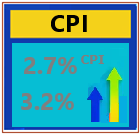
Over the 12 months ended July 2021, the Consumer Price Index for All Urban Consumers increased 5.4 percent. Food prices increased 3.4 percent over the last 12 months. Within the food category, food at home prices rose 2.6 percent, including a 5.9-percent increase in prices for meat, poultry, fish, and eggs.
Prices that Americans pay for everyday goods and services rose in July as pent-up demand for travel and restaurants kept inflation hot, but jumped about as much as economists had expected. The Labor Department reported Wednesday that its consumer price index rose 5.4% in July from a year earlier, in line with June’s figure and matching the largest jump since August 2008. The government said CPI increased 0.5% on a month-over-month basis, matching a consensus forecast from economists surveyed by Dow Jones.
So-called core inflation, which excludes energy and food, rose by 0.3% last month, shy of a forecasted 0.4% increase and well below June’s rise of 0.9%. The core figure is up 4.3% over the last year, a slight deceleration from June’s 4.5%. Economists often consider core CPI to be a more reliable indicator since it’s insulated from the frequent swings in petroleum and food prices.
Jobless Claims
U.S. jobless claims total 375,000, falling for a third straight week New claims for jobless benefits totaled 375,000 last week, the Labor Department said, matching estimates from economists surveyed by Dow Jones. The reading for the previous week was revised upward by 2,000 to 387,000 claims. The number of insured unemployment claims, a measure of continuing jobless claims, fell to 2.866 million for the last week of July, according to Thursday’s report. That is the lowest level since mid-March 2020.
Productiviy and Cost
U.S. worker productivity growth slowed in the second quarter and labor costs were far weaker than previously estimated in the first quarter, the Labor Department said on Tuesday. Nonfarm productivity, which measures hourly output per worker, increased at a 2.3% annualized rate last quarter. Data for the first quarter was revised lower to show productivity rising at a 4.3% rate instead of the previously reported 5.4% pace. Economists polled by Reuters had expected productivity to rise at a 3.5% rate. Productivity jumped early in the pandemic before slumping in the final three months of 2020, and has since rebounded.
Nonfarm business sector labor productivity increased 2.3 percent in the second quarter of 2021, the U.S. Bureau of Labor Statistics reported today, as output increased 7.9 percent and hours worked increased 5.5 percent. ..
The see-sawing has been partly attributed to the cratering of lower-wage industries, like leisure and hospitality, which have been reopening over the past few months at an increasingly brisk pace. Compared to the second quarter of 2020, productivity rose at a 1.9% pace. Hours worked increased at a 5.5% rate last quarter, accelerating from a revised 4.0% growth pace in the January-March period. Overall output is now 1.2% above pre-pandemic levels but hours worked remain 2.8% below it, the report also showed. The resurgence in economic activity has not been matched by people flooding back into the workforce. On Monday, U.S. job openings jumped to a fresh record high in June, Labor Department data showed.
Treasury Budget
The U.S. government on Wednesday posted a July 2021 budget deficit of $302 billion, a record for that month, as COVID-19 relief spending stayed elevated while receipts returned to a more normal pace after a delayed July tax deadline last year. The Treasury Department said the July deficit compared to a year-earlier $63 billion budget gap. Receipts for the month totaled $262 billion, down 54% percent from July 2020, while outlays were $564 billion, down 10% from the year-earlier period. The U.S. deficit for the first 10 months of fiscal 2021 came to $2.540 trillion, down 10% from the year-earlier record of $2.807 trillion. A U.S. Treasury official said that the smaller year-to-date outlays and deficits reflected some tapering of COVID-19 relief spending, with Labor Department outlays for supplemental unemployment benefits down 8% to $359 billion, and Small Business Administration outlays down 40% to $338 billion.
Producer Price Index PPI
Producer prices soar 7.8% annually in July, most on record. Producer prices accelerated at the fastest annual pace on record in July as supply chain disruptions and materials shortages continued to put upward pressure on costs. The producer price index for final demand increased at a 7.8% pace for the 12 months ended July, according to the Labor Department. The July print was faster than the 7.3% pace recorded in June and ahead of the 7.3% rate that analysts surveyed by Refinitiv were expecting. The reading was the strongest since recordkeeping began in November 2010. Producer prices rose 1% in July, matching the increase from June. Analysts were anticipating prices would grow at a 0.6% pace.
Consumer Sentiment UM
A key consumer sentiment reading saw a dramatic drop in early August as the delta variant of Covid-19 increased fears about the path of the economy, the University of Michigan said Friday. The consumer sentiment index tumbled to 70.2 in its preliminary August reading. That is down more than 13% from July’s result of 81.2 and below the April 2020 mark of 71.8 that was lowest of the pandemic era. It was the lowest reading for the measure since 2011. Economists surveyed by Dow Jones were expecting a reading of 81.3 for August. And a sudden drop of that magnitude is extremely rare for the index.
U.S. Import and Export Price Indexes
Prices for U.S. imports increased 0.3 percent in July 2021, after advancing 1.1 percent the previous month, the U.S. Bureau of Labor Statistics reported today. The July increase was driven by higher fuel prices. U.S. export prices rose 1.3 percent in July following a 1.2-percent advance in June. U.S. import prices increased 0.3 percent in July, after advances of 1.1 percent in June and 1.3 percent in May. The July rise is the smallest monthly increase since the index ticked up 0.1 percent in November. Prices for U.S. imports advanced 10.2 percent from July 2020 to July 2021, led by higher prices for both nonfuel and fuel products.
|