10-Year Treasury Yield
U.S. Treasury yields fell on Tuesday as investors sought safety amid rising tensions in the Middle East. The yield on the 10-year Treasury slid more than 9 basis points to 3.713%. The 2-year Treasury yield dropped 5.5 basis points to trade at 3.596%. Yields and prices move in opposite directions. One basis point equals 0.01%.
Chicago PMI Modest upturn in Chicago PMI points to slight expansion in manufacturing sector. The Chicago Purchasing Managers' Index (PMI), a key indicator of the economic health of the manufacturing sector in the Chicago region, witnessed a minor uptick, as per the latest data. The actual PMI figure came in at 46.6, marking a slight increase from the previous and forecasted readings. This new figure of 46.6, while still below the crucial 50 mark that separates expansion from contraction, indicates a marginal improvement in the manufacturing sector's performance. It was slightly higher than the forecasted figure of 46.1, suggesting that the sector performed a bit better than analysts had predicted.
ISM Manufacturing Index
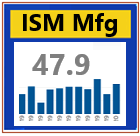
The Institute of Supply Management's manufacturing index, as market participants tried to gain fresh insight into the state of the US economy amid ongoing fears surrounding a potential US recession. The ISM's manufacturing PMI was flat month-on-month in September at 47.2, falling slightly short of expectations for a reading of 47.5 and continuing to point to a contraction in the manufacturing sector as demand continued to be weak and output fell. Economic activity in the manufacturing sector contracted in September for the sixth consecutive month and the 22nd time in the last 23 months. The Manufacturing PMI® registered 47.2 percent in September, matching the figure recorded in August. The overall economy continued in expansion for the 53rd month after one month of contraction in April 2020
PMI Mfg Final
US Sept S&P Global final manufacturing PMI 47.3 vs 47.0 preliminary. The September PMI survey brings a whole slew of disappointing economic indicators regarding the health of the US economy. Factories reported the largest monthly drop in production for 15 months in response to a slump in new orders, in turn driving further reductions in employment and input buying as producers scaled back operating capacity. Prelim was 47.0 and Prior month was 47.9.
JOLTS
A sign of strength in the labor market: Job openings increased in August. The number of available jobs in the US grew in August, signaling an undercurrent of strength in the labor market at a time when its vitals are being carefully monitored by the Federal Reserve. There were an estimated 8.04 million job openings in August, up from an upwardly revised 7.71 million in July, according to new data released Wednesday by the Bureau of Labor Statistics. The latest tally equates to 1.1 available jobs for every person looking for one, BLS data shows. Economists were expecting the number of available jobs to land at 7.682 million, a slight increase from July’s initial total, according to FactSet consensus estimates.
Construction Spending
US construction spending falls in August 2024 on single-family homebuilding. U.S. construction spending unexpectedly fell in August amid a sharp drop in outlays on single-family housing projects, but declining borrowing costs could stimulate activity in the months ahead. The Commerce Department's Census Bureau said on Tuesday construction spending dipped 0.1% after a downwardly revised 0.5% drop in July. Economists polled by Reuters had forecast construction spending would edge up 0.1% after a previously reported 0.3% decrease. Construction spending increased 4.1% on a year-on-year basis in August.
Geopolitical Risk
US believes Iran is preparing imminent attack on Israel. The White House says it’s preparing to help defend Israel against a missile attack, as the IDF continues its ground offensive in southern Lebanon. Tensions between Israel and Iran have ratcheted up significantly in recent weeks as Israel has stepped up its efforts against Hezbollah in Lebanon. Israel has killed multiple Hezbollah leaders. Here’s who they were – and the key players that remain.
MBA Purchase Applications
Mortgage applications decreased 1.3 percent from one week earlier. Mortgage Applications Decrease in Latest MBA Weekly Survey. The Market Composite Index, a measure of mortgage loan application volume, decreased 1.3 percent on a seasonally adjusted basis from one week earlier. On an unadjusted basis, the Index decreased 1 percent compared with the previous week. The Refinance Index decreased 3 percent from the previous week and was 186 percent higher than the same week one year ago. The seasonally adjusted Purchase Index increased 1 percent from one week earlier. The unadjusted Purchase Index increased 1 percent compared with the previous week and was 9 percent higher than the same week one year ago. The refinance share of mortgage activity decreased to 54.9 percent of total applications from 55.7 percent the previous week. The adjustable-rate mortgage (ARM) share of activity decreased to 5.8 percent of total applications
ADP Employment Report
US Hiring in ADP Data Rebounds After Five Months of Easing. Private payrolls rose 143,000 in September, above forecast. ‘Stronger hiring didn’t require stronger pay growth,’ ADP says. US Companies Add More Jobs Than Forecast at 143,000: ADP. Hiring at US companies picked up in September, snapping a five-month stretch of slower payrolls growth. Private payrolls increased 143,000 last month after an August advance that was the weakest since March 2023, according to the ADP Research Institute in collaboration with Stanford Digital Economy Lab. The Bloomberg survey of economists had called for a gain of 125,000 jobs.
Oil - Commodity
The price of oil has jumped 5% after US President Joe Biden said the US was discussing possible strikes by Israel on Iran’s oil industry. Iran is the seventh largest oil producer in the world, exporting around half its production abroad, mainly to China. Since Iran’s missile attack on Israel on Monday, the price of benchmark Brent crude oil has risen 10% to $77 a barrel, although this remains below levels seen earlier this year.
Jobless Claims
Weekly jobless claims increase 6,000 to 225,000. Continuing claims fall 1,000 to 1.826 million. Impact of strikes, Helene may distort labor market. Services sector activity accelerates in September. The number of Americans filing new applications for unemployment benefits increased marginally last week, but the devastation unleashed by Hurricane Helene in the U.S. Southeast and strikes at Boeing (BA.N), opens new tab and ports could distort the labor market picture in the near-term. Initial claims for state unemployment benefits increased by 6,000 last week to a seasonally adjusted 225,000 for the week ended Sept. 28. Economists polled by Reuters had forecast 220,000 claims for the latest week. Unadjusted claims fell 1,066 to 180,647 last week. The decline, however, was less than the drop of 5,692 that had been anticipated by the model used by the government to strip out seasonal fluctuations from the data.
PMI Composite Final
Service sector reports strong growth and steeper price pressures in September. Business Activity Index posted 55.2 in September, down from 55.7 in August but still signaling a marked monthly increase in service sector output at the end of the third quarter, and one that was among the strongest in the past two-and-a-half years. The S&P Global US Composite PMI Output Index posted 54.0 in September, down from 54.6 in August but still signaling a solid monthly improvement in business activity at the end of the third quarter. Divergent trends between the two monitored sectors persisted, however, with growth centred on the service sector as the manufacturing downturn deepened.
Factory Orders
US factory orders fall by 0.2% in August 2024. Factory orders in the United States were down by 0.2% in August compared to the previous month, landing at $590.4 billion, a new report by the Census Bureau said on Thursday. New orders for manufactured durable goods remained stable at $289.6 billion, while manufactured nondurable goods orders dropped 0.5% to $300.8 billion. Shipments declined by 0.5% month-on-month to $590.1 billion, while unfilled orders rose by 0.4% to $1,391.4 billion. Inventories grew by 0.1% to $860.2 billion, with the inventories-to-shipments ratio at 1.46, up from 1.45 in July.
ISM Service Index
ISM nonmanufacturing PMI rose to 54.9 in September from 51.5 in August. New orders index surged to 59.4, highest since February 2023. Services employment index dropped to 48.1. U.S. services sector activity jumped to a 1-1/2-year high in September amid strong growth in new orders, more evidence that the economy remained on a solid footing in the third quarter. The Institute for Supply Management (ISM) said on Thursday that its nonmanufacturing purchasing managers (PMI) index accelerated to 54.9 last month, the highest level since February 2023, from 51.5 in August. A PMI reading above 50 indicates growth in the services sector, which accounts for more than two-thirds of the economy. The ISM views PMI readings above 49 over time as generally indicating an expansion of the overall economy. Economists polled by Reuters had forecast the services PMI rising to 51.7.
Fed Balance Sheet
Fed balance sheet drawdown may go on if jobless rate does not move higher. Following a jumbo 50-basis point interest rate cut by the Fed last month, Fed Chair Jerome Powell said the central bank is not considering halting balance sheet reductions, citing "still abundant" reserves that are expected to remain so for some time. As a result, he said continuing so-called quantitative tightening, or the Fed's process of drawing down the liquidity it added through bond purchases made during the COVID-19 pandemic, is necessary. So far, quantitative tightening has brought down the Fed's holdings from $9 trillion in 2022 to currently around $7.1 trillion.
The Fed's balance sheet is a weekly report presenting a consolidated balance sheet for all 12 Reserve Banks. The report is officially named Factors Affecting Reserve Balances: H.4.1 report. Total Assets W/W: $-34,270 B from $-15,497 B.
Mortgage Rates - 30 Year Fixed
The average contract interest rate for 30-year fixed-rate mortgages with conforming loan balances ($766,550 or less) increased to 6.14 percent from 6.13 percent, with points increasing to 0.61 from 0.57 (including the origination fee) for 80 percent loan-to-value ratio (LTV) loans. The effective rate increased from last week. The average contract interest rate for 30-year fixed-rate mortgages with jumbo loan balances (greater than $766,550) increased to 6.50 percent from 6.47 percent, with points decreasing to 0.36 from 0.50 (including the origination fee) for 80 percent LTV loans. The effective rate remained unchanged from last week. The average contract interest rate for 15-year fixed-rate mortgages increased to 5.51 percent from 5.47 percent, with points increasing to 0.62 from 0.52 (including the origination fee) for 80 percent LTV loans. The effective rate increased from last week.
Non Farm Payroll
U.S. job creation roared higher in September as payrolls surged by 254,000. Nonfarm payrolls surged by 254,000 in September, up from a revised 159,000 in August and better than the 150,000 Dow Jones consensus forecast. The unemployment rate fell to 4.1%, down 0.1 percentage point, as the survey of household employment showed an even stronger picture, with a gain of 430,000. Average hourly earnings increased 0.4% on the month and were up 4% from a year ago. Both figures were ahead of respective estimates. The U.S. economy added far more jobs than expected in September, pointing to a vital employment picture as the unemployment rate edged lower, the Labor Department reported Friday. Nonfarm payrolls surged by 254,000 for the month, up from a revised 159,000 in August and better than the 150,000 Dow Jones consensus forecast. The unemployment rate fell to 4.1%, down 0.1 percentage point.
Unemployment Rate
The unemployment rate fell to 4.1%, down 0.1 percentage point, as the survey of household employment showed an even stronger picture, with a gain of 430,000. Average hourly earnings increased 0.4% on the month and were up 4% from a year ago. Both figures were ahead of respective estimates.
Hedging - Gold
Gold loses ground after strong US Nonfarm Payrolls data. Gold falls after better-than-expected US Nonfarm Payrolls shows the US labor market is healthy. Gold (XAU/USD) weakens into the $2,650s on Friday as traders sell the asset and the US Dollar strengthens on the back of strong US labor market data.
S&P 500 Index - Week Performance
mmmm |