10-Year Treasury Yield
The 10-year U.S. Treasury yield edged higher on Monday as investors continued to assess how the latest jobs data could impact the Federal Reserve’s interest rate decision next week. The yield on the 10-year Treasury rose less than 2 basis points to 4.17%, regaining some ground after losing steam last week. The 2-year Treasury yield was also up less than 2 basis points at 4.112%. Yields and prices moved inversely to one another, and one basis point equals 0.01%.
Whosale Trade (Pre)
Wholesale inventories rebound, meet forecast with 0.2% increase. The latest data on Wholesale Inventories has been released, showing a turnaround in the total value of goods held in inventory by wholesalers. The actual figure came in at 0.2%, meeting the forecasted number and indicating a positive shift from the previous month. This 0.2% increase aligns perfectly with the forecasted number, displaying a recovery from the previous month's dip. In the previous period, inventories had contracted by 0.2%, a negative turn that raised concerns among economists and market watchers.Nevertheless, the return to growth in Wholesale Inventories is a positive sign for the broader economy, potentially indicating increased business confidence and a stronger demand outlook.
Productivity and Costs
Workers continue to be more productive over time, and the improvements have been enough to take the edge off of wage increases that otherwise have been a bit too high for the Fed's inflation comfort zone. Unit labor costs to business, one key to whether a tight job market is feeding into price pressures, have been rising at a more tempered rate as a result. Nonfarm business sector labor productivity increased 2.2 percent in the third quarter of 2024, the U.S. Bureau of Labor Statistics reported today, reflecting no revision from the preliminary estimate. Output and hours worked were also unrevised, increasing 3.5 percent and 1.2 percent respectively. (All quarterly percent changes in this release are seasonally adjusted annualized rates.) From the same quarter a year ago, nonfarm business sector labor productivity increased 2.0 percent in the third quarter of 2024, as previously reported.
Geopolitical Risk
mmmm
MBA Purchase Applications
Mortgage refinance demand surges 27%, as interest rates drop for the third straight week. The average contract interest rate for 30-year fixed-rate mortgages with conforming loan balances ($766,550 or less) decreased to 6.67% from 6.69%. Applications to refinance a home loan surged 27% week to week and were 42% higher than the same week one year ago. Applications for a mortgage to purchase a home fell 4% for the week and were 4% higher than the same week one year ago. Applications to refinance a home loan surged 27% week to week and were 42% higher than the same week one year ago. The percentages are large, likely because the base volume is still so small. Most borrowers today have mortgages with rates well below what is now being offered. From 2020 through the first half of 2022, rates were below 4%. Mortgage rates last week were 40 basis points lower than they were the same week one year ago.
Consumer Price Index - CPI
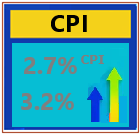
The consumer price index showed a 12-month inflation rate of 2.7% after increasing 0.3% on the month, the Bureau of Labor Statistics reported Wednesday. The annual rate was 0.1 percentage point higher than October. Excluding food and energy costs, the core CPI was at 3.3% on an annual basis and 0.3% monthly. The 12-month core reading was unchanged from a month ago. Annual inflation rate accelerates to 2.7% in November, as expected. The consumer price index showed a 12-month inflation rate of 2.7% after increasing 0.3% on the month. Excluding food and energy costs, the core CPI was at 3.3% on an annual basis and 0.3% monthly. All of the figures were in line with forecasts. The report further solidified the market outlook for a cut, with traders raising the odds to 99%, according to the CME Group’s FedWatch measure.
Oil - Commodity
Crude Oil in orbit around $70.00, looking for a weekly close above it. Crude Oil is making its way back above $70.00. OPEC+ report was a good element for Oil prices to head higher, but traders are still warning for the 2025 projections when President-elect Donald Trump will stay in the White House. Several commitments have already been put in place to drill more US Oil and become a bigger exporter in an already oversupplied market.
Treasury Budget
US budget deficit climbs to $367 billion in November on calendar payment shifts. The U.S. government posted a $367 billion budget deficit for November, up 17% from a year earlier, as calendar adjustments for benefit payments boosted outlays by some $80 billion compared to the same month in 2023, the Treasury Department said on Wednesday. The Treasury Department said that without the acceleration of December payments for the Medicare and Social Security programs into November, the deficit last month would have been about $29 billion, or 9% lower than last year.
Jobless Claims
First-time claims for unemployment insurance totaled a seasonally adjusted 242,000 for the week ending Dec. 7, versus the 220,000 forecast and up 17,000 from the prior period. First-time claims for unemployment insurance totaled a seasonally adjusted 242,000 for the week ending Dec. 7, considerably higher than the 220,000 forecast and up 17,000 from the prior period.
Producer Price Index
The producer price index, or PPI, which measures what producers get for their products at the final-demand stage, increased 0.4% for the month, higher than the Dow Jones consensus estimate for 0.2%. On an annual basis, PPI rose 3%, the biggest advance since February 2023.. Wholesale prices rose 0.4% in November, more than expected. The producer price index increased 0.4% for November, higher than the Dow Jones consensus estimate for 0.2%. However, excluding food and energy, core PPI increased 0.2%, meeting the forecast.However, excluding food and energy, core PPI increased 0.2%, meeting the forecast. Also, subtracting trade services left the PPI increase at just 0.1%. The year-over-year increase of 3.5% also was the most since February 2023.
Fed Balance Sheet
Level Prior $6.896 T, Actual $6.898 T. Total Assets - W/W Prior $-9.313 B Actual $1.658 B Reserve Bank Credit - W/W Prior $-13.686 B, Actual $-4.330 B.
Mortgage Rates
Because 15- and 30-year mortgage rates are fixed and mostly tied to Treasury yields and the economy, they are not falling in step with Fed policy. And since most people have fixed-rate mortgages, their rate won’t change unless they refinance or sell their current home and buy another property.
Mortgage rates fell again last week, and while the drop wasn’t huge, it was enough to spur current homeowners to look for some savings. The surge in refinances was behind a 5.4% increase in total mortgage demand compared with the previous week, according to the Mortgage Bankers Association’s seasonally adjusted index. The average contract interest rate for 30-year fixed-rate mortgages with conforming loan balances ($766,550 or less) decreased to 6.67% from 6.69%, with points falling to 0.66 from 0.67 (including the origination fee) for loans with a 20% down payment. That was the third straight weekly decline.
Imports and Exports Prices
Import inflation is low now, but Trump tariffs pose fresh threat. The cost of imported goods aren’t adding much to inflation now, but rising prices could become a bigger threat next year if President-elect Donald Trump goes ahead with the stiffest U.S. tariffs in decades. The import price index rose a a scant 0.1% in November, the government said Friday. Inflation Risks Loom as U.S. Import Prices Edge Higher on Fuel Costs. Import prices rose 0.1% in November, defying forecasts of a 0.2% drop, with fuel costs driving the increase. Export prices held steady in November, with agricultural exports falling 0.4% on lower soybean and fruit prices. Annual U.S. import prices rose 1.3%, their strongest 12-month gain since mid-2024, despite fuel declines. Traders anticipated a -0.2% decline in monthly U.S. import prices for November 2024, but the actual increase of 0.1% exceeded expectations, driven by higher fuel costs. Meanwhile, export prices remained flat following a 1.0% rise in October. These trends highlight continued cost pressures in the international trade sector. The unexpected rise in import prices adds to inflationary pressures, complicating the Federal Reserve’s policy outlook. Higher import costs, particularly for energy, could sustain upward pressure on Treasury yields as the Fed remains vigilant against inflation.
Hedging - Gold
Fed expected to cut rates by 25 bps, with Powell’s outlook key for 2025 easing pace. U.S. dollar strengthens as cautious Fed signals slower rate cuts in 2025. Treasury yields hover above 4.3%, reinforcing pressure on non-yielding assets like gold. Core inflation remains at 3.3%, keeping gold prices in focus for inflation-hedging demand. Analysts expect gold strength in late 2025 as softer dollar and lower real rates emerge.
S&P 500 Index - Week Performance
mmm |