10-Year Treasury Yield
10-year Treasury yield rises as investors look ahead to key jobs data. The 10-year U.S. Treasury yield moved higher on Monday ahead of a series of key jobs data set to be published throughout the week. The 10-year Treasury yield rose more than 3 basis points to 4.63%, while the 2-year Treasury dipped nearly 1 basis points to 4.27%. S&P 500 wavers, pressured by higher Treasury yields.
PMI Services Final
US December S&P Global final services PMI 56.8 vs 58.5 preliminary. This is still the best reading since March 2022, though not as good as it initially looked. The strong service sector PMI reading for December sets the US economy up for a good start to 2025 but, with growth as strong as this, it’s understandable that policymakers are taking a more cautious approach to lowering interest rates. However, a key focus in the coming months will be the potential vulnerability of the economy to any major change in the interest rate outlook, especially as financial services activity has been an important engine of growth in late 2024, partly on the anticipation of a further lowering of borrowing costs.
Factory Orders
Weak demand for aircraft weighs down US factory orders in November 2024. New orders for U.S.-manufactured goods fell in November amid weakness in demand for commercial aircraft while business spending on equipment appeared to have slowed in the fourth quarter, government data showed on Monday. Factory orders dropped 0.4% after an upwardly revised 0.5% gain in October, the Commerce Department's Census Bureau said. Economists polled by Reuters had forecast factory orders slipping 0.3% after a previously reported 0.2% rise in October. Factory orders edged up 0.1% year-on-year in November. Manufacturing accounts for 10.3% of the economy.
US Dollar Index
Asian central banks face strong U.S. dollar. Asian currencies, such as the Chinese yuan, the Japanese yen and the Korean won have fallen against the U.S. dollar since Trump won the presidential election in November. That poses a conundrum for Asia’s central banks: A weaker currency would boost exports but might increase imported inflation, complicating the ability of banks to steer domestic economic policy.
US Trade Balance
The U.S. Census Bureau and the U.S. Bureau of Economic Analysis announced today that the goods and services deficit was $78.2 billion in November, up $4.6 billion from $73.6 billion in October, revised. US Trade Balance Dips Slightly Below Forecast, Widens Deficit. The latest report on the United States Trade Balance has been released, indicating a deficit of $78.2 billion. This figure, while slightly better than the forecasted deficit of $78.3 billion, still presents a widening gap compared to the previous figure. The Trade Balance measures the difference in value between imported and exported goods and services over the reported period. A positive number indicates that more goods and services were exported than imported. In this case, the negative figure signals that the United States imported more than it exported. The $78.2 billion deficit, while marginally better than the forecasted $78.3 billion, still represents a significant increase from the previous deficit of $73.6 billion. This suggests a growing imbalance in the country's trade activities, with imports continuing to outpace exports.
ISM Services Index
Services index shows big jump in prices for December as companies fear tariffs. The ISM services index Tuesday posted a reading of 54.1%, up 2 percentage points from November and above the Dow Jones consensus forecast of 53.4%. Along with the better overall reading, the prices index jumped to 64.4%, an increase of 6.2 points or more than 10%. It was the first time the index had eclipsed 60% since January of 2024.. ISM services PMI beats expectations, pushes yields higher. The U.S. services sector grew at a faster-than-expected pace in December, raising concern among investors about whether the Fed will be able to cut rates as much as Wall Street hopes, according to the Institute for Supply Management. The ISM services sector PMI came in at 54.1. Economists polled by Dow Jones expected a print of 53.4. A key driver of that beat was the PMI’s price index — which soared 6.2 points to 64.4 — signaling there may be more inflation on the horizon.
JOLTS
Jolts and Ism did not show weakness like markets thought. S&P 500 Turns Lower, Bond Yields Surge After JOLTS Data. FOMC on hold for January unless payrolls shows surprising weakness, even then it will be viewed with skepticism.The U.S. job market remains resilient as the number of available jobs continues to stay elevated. November job openings, a measure of labor demand, rose to 8.10 million, according to the Labor Department's monthly Job Openings and Labor Turnover Survey (JOLTS) report. This marks an increase from 7.74 million job openings in October. The data exceeded expectations, as economists had forecasted a relatively unchanged figure of around 7.73 million. A JOLTS report indicated that job openings nudged higher in November while fewer workers left their jobs. The Labor Department’s Job Openings and Labor Turnover Survey showed available positions rising to 8.1 million, an increase of 259,000 for the month and higher than the 7.7 million estimate from Dow Jones. At the same time, quits fell to 3.06 million, a decline of 218,000. The level of job openings to available workers held around 1.1 to 1. The number of job openings on the last business day of November stood at 8.09 million, the US Bureau of Labor Statistics (BLS) reported in the Job Openings and Labor Turnover Survey (JOLTS) on Tuesday. This reading followed the 7.83 million reported in October and came in above the market expectation of 7.7 million.
Geopolitical Risk
Euro zone inflation rose to 2.4% in December, meeting expectations. Annual inflation in the euro zone rose for a third straight month to reach 2.4% in December, statistics agency Eurostat said Tuesday. The preliminary reading was in line with the forecast of economists polled by Reuters and marked an increase from a revised 2.2% print in November. Core inflation held at 2.7% for a fourth straight month while services inflation nudged up to 4% from 3.9%.
US 10-yr Treasury yields hit highest since April. UK 10-yr gilt yields at highest since 2008. Bonds selloff ripples into currencies, stocks. A sharp selloff in some of the world's biggest government bond markets and a continued rise in the dollar sent shockwaves through financial markets, with the pain seen deepening as uncertainty grows over U.S. President-elect Donald Trump's policies. On Wednesday, the 10-year Treasury yield , underpinning trillions of dollars in daily global transactions, jumped to above 4.7%, their highest since April, and UK peers hit their highest since 2008.
MBA Purchase Applications
Mortgage rates hit highest level since July, crushing application demand. Applications to refinance a home loan rose 2% from the previous week but were 6% lower than the same week one year ago. Rates are now 18 basis points higher than they were one year ago. As for the weekly gain, volume in refinances is so low right now, that percentages are skewing larger than they normally would. Applications for a mortgage to purchase a home fell 7% for the week and were 15% lower than the same week one year ago. There is considerably more supply of homes for sale now than there was last January, but higher rates and higher home prices are clearly keeping buyers on the sidelines. Purchase applications declined for both conventional and government loans and dropped to the slowest weekly pace since February 2024. Total mortgage application volume fell 3.7% compared with the previous week, according to the Mortgage Bankers Association’s seasonally adjusted index. An additional adjustment was made for the New Year’s holiday.
ADP Employment Report
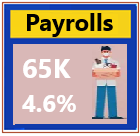
Private sector job creation eased more than expected in December while wages grew at the slowest pace in nearly 3½ years, payment processing firm ADP reported Wednesday. Private sector companies added 122,000 jobs in December, less than expected, ADP says. Companies added a seasonally adjusted 122,000 jobs for the month, down from 146,000 additions in November and less than the Dow Jones consensus forecast for 136,000. On wages, pay grew at a 4.6% rate from a year ago, the slowest pace since July 2021. Companies added a seasonally adjusted 122,000 jobs for the month, down from 146,000 additions in November and less than the Dow Jones consensus forecast for 136,000. It was the smallest increase since August.
Jobless - Claims
The Labor Department on Wednesday reported that initial claims for unemployment insurance totaled just 201,000 for the week ended Jan. 4. That was well below the 215,000 estimate and the lowest level since February 2024.
Wholesale Trade - Pre
Wholesale inventories remain steady, meeting forecasts. The latest data on wholesale inventories has been released, revealing that the total value of goods held in inventory by wholesalers has remained steady, with no change from the previous figure. The actual figure for the wholesale inventories came in at -0.2%, which aligns perfectly with the forecasted number. This consistency in the data indicates that the market predictions were accurate and that the wholesale sector is maintaining a steady pace, without any unexpected fluctuations. This demonstrates that there has been no change in the total value of goods held in inventory by wholesalers, indicating a stable market. The stability of the wholesale inventories is a positive sign for the USD. As per the economic principle, a higher than expected reading is considered negative or bearish for the USD, while a lower than expected reading is taken as positive or bullish. In this case, the reading was as expected, signaling neither a bearish nor bullish trend, but rather a steady, consistent performance in the wholesale inventories sector.
Commodities - Oil
Oil prices edge higher as markets weigh demand against US inventories. Oil prices rose slightly on Thursday as investors factored in firm winter fuel demand expectations despite large U.S. fuel inventories and macroeconomic concerns. Brent crude futures were up 35 cents, or 0.5%, at $76.51 a barrel by 1246 GMT. U.S. West Texas Intermediate crude futures gained 30 cents, or 0.4%, to $73.62. Both benchmarks fell more than 1% on Wednesday as a stronger dollar and a bigger than expected rise in U.S. fuel stockpiles pressured prices.
FOMC Minutes
On paper, minutes for the Fed’s December meeting spelled bad news for investors. Officials were worried about inflation and the impact of Trump’s stated policies (though Trump was not explicitly named). Federal Reserve officials at their December meeting expressed concern about inflation and the impact that President-elect Donald Trump’s policies could have, indicating that they would be moving more slowly on interest rate cuts because of the uncertainty, minutes released Wednesday showed. Fed officials are worried about the inflation impacts from Trump’s policies, minutes show. Federal Reserve officials at their December meeting expressed concern about inflation and the impact that President-elect Donald Trump’s policies could have on efforts to reduce it. The policymakers said they will move more slowly on interest rate cuts due to the uncertainty, minutes of the meeting showed Wednesday. The minutes included at least four mentions about the impact that changes in immigration and trade policy could have on the U.S. economy.
Consumer Credit
US Consumer Borrowing Drops on Plunge in Credit-Card Balances. Total credit dropped $7.5 billion after a revised $17.3 billion gain in October, according to Federal Reserve data released Wednesday. The median estimate in a Bloomberg survey of economists called for a $10.5 billion advance. The figures aren’t adjusted for inflation. The data suggest consumers are making an effort to pay down credit-card balances as borrowing rates remain near a record well above 20%. Americans have relied more on credit in recent years to help support spending amid persistent inflation.
Hedging Gold
Some analysts suggest that gold is under pressure because a robust labor market could prompt the Federal Reserve to shorten its monetary easing cycle this year. Last month, the U.S. central bank indicated it expects to cut interest rates only twice in 2025, a reduction from its previous projection of four rate cuts. Gold price struggles as U.S. JOLTS showed plenty of jobs are available. The gold market is struggling to maintain its earlier gains in response to the positive labor market data. Spot gold last traded at $2,648.60 per ounce, up 0.48% on the day. However, prior to the report's release, gold prices had risen
Jimmy Carter day of mourning - Markets Closed
Stock Markets: The New York Stock Exchange and the Nasdaq will be closed for the day. Bond markets will operate on a reduced schedule, closing early at 2.00 pm ET. President Joe Biden declared this coming January 9 a National Day of Mourning in honor of former President Jimmy Carter, who passed away on December 29 at the age of 100. Carter, the 39th President of the United States, is remembered not only for his term in office from 1977 to 1981, but also for his great humanitarian efforts following his presidency
Mortgage Rates
The average contract interest rate for 30-year fixed-rate mortgages with conforming loan balances ($766,550 or less) increased to 6.99% from 6.97%, with points decreasing to 0.68 from 0.72 (including the origination fee) for loans with a 20% down payment. That is the highest rate since July 2024.
Non Farm Payroll
U.S. payrolls grew by 256,000 in December, much more than expected; unemployment rate falls to 4.1%. Nonfarm payrolls surged by 256,000 for the month, up from 212,000 in November and above the 155,000 forecast. Job growth was much stronger than expected in December, likely providing the Federal Reserve less incentive to cut interest rates this year. Nonfarm payrolls surged by 256,000 for the month, up from 212,000 in November and above the 155,000 forecast from the Dow Jones consensus, the Bureau of Labor Statistics reported Friday.
Unemployment Rate
The unemployment rate edged down to 4.1%, one-tenth of a point below expectations. A broader jobless measure moved down to 7.5%, a decrease of 0.2 percentage point and the lowest since June 2024. Average hourly earnings increased 0.3% on the month, which was in line with forecasts, but the 12-month gain of 3.9% was slightly below the outlook. Stock market futures plunged after the report while Treasury yields soared as traders price in a lower probability of Fed rate cuts this year.
S&P 500 Index - Week Performance
Open 2025 week 02 at 5,902 and close at 5,827. Negative -2.60%
Fed Balance Sheet
Level $6.854 T. Total Assets -W/W $1.063 B. Reserve Bank Credit - W/W $-12.243 B. |