10-Year Treasury Yield
Treasury yields fall as investors weigh economic outlook, yield curve briefly. U.S. Treasury yields dropped Wednesday as investors assessed the outlook for the economy along with the spread between the 2-year and 10-year note yields. The 10-year Treasury fell 6 basis points to 3.782%. The 2-year Treasury pulled back nearly 11 basis points to 3.781%.
PMI Manufacturing Final
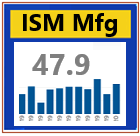
US August final S&P Global manufacturing PMI 47.9 vs 48.0 prelim. Prelim was 48.0. July final was 46.8. Production declines for first time in 7 months. New orders fall at fastest pace since June 2023. Employment drops for first time this year. Input cost inflation accelerates to 16-month high.
ISM Manufacturing Index
Weak manufacturing measures raise specter of U.S. economic slowdown. The ISM monthly survey of purchasing managers showed that just 47.2% reported expansion in August, above the July reading but below the consensus forecast. Another weak economic reading raises the probability the Fed will be cutting interest rates by at least a quarter percentage point later this month.
MBA Purchase Applications
Mortgage demand is now heavily skewed toward refinancing, as interest rates declined for the fifth straight week. Total mortgage application volume rose just 1.6% last week, compared with the previous week, according to the Mortgage Bankers Association’s seasonally adjusted index. The average contract interest rate for 30-year fixed-rate mortgages with conforming loan balances ($766,550 or less) decreased to 6.43% from 6.44%, with points increasing to 0.56 from 0.54 (including the origination fee) for loans with a 20% down payment. The rate was 78 basis points higher than the same week one year ago. Applications to refinance a home loan fell 0.3% for the week but were 94% higher than a year ago. That might seem like a massive increase, but it is coming off a very low number. Still, it is the one bright spot in a business that fell off a cliff due to higher interest rates and very weak homebuying.
US Trade Balance
U.S. trade gap hits highest level in more than two years in sign of consumer strength. A deficit of $78.8 billion was expected in July for total goods and services trade which would compare with a $73.1 billion deficit in June. Advance data on the goods side of July's report showed a stalling out for exports and a steep $6.1 billion rise in the deficit.Trade gap hits $78.8 billion as imports surge. The U.S. international trade deficit widened 7.9% in July to $78.8 billion from a revised $73 billion in the prior month, the Commerce Department said Wednesday. This is the largest monthly trade gap since June 2022. The wider trade deficit has been a drag on GDP growth for the first two quarters of 2024. This report confirms that trade continues to drag down GDP growth at the start of the third quarter.
Factory Orders
Factory orders rise in July after two months of weakness. Orders rise 5%, but excluding transportation were up a slight 0.4%. Orders for U.S. manufactured goods rose 5% in July, the Commerce Department said Wednesday. The gain follows two straight monthly declines. The rise in factory orders in July was in line with the consensus forecast of economists surveyed by the Wall Street Journal.
JOLTS - Employment
Job openings fell more than expected in July in another sign of labor market softening. Job openings slumped to their lowest level in three and a half years in July, the Labor Department reported Wednesday in another sign of slack in the labor market. The department’s closely watched Job Openings and Labor Turnover Survey showed that available positions fell to 7.67 million on the month, off 237,000 from June’s downwardly revised number and the lowest level since January 2021. While the job openings level declined, layoffs increased to 1.76 million, up 202,000 from June.Job openings fall to lowest level since 2021. It’s getting harder to find work.
Beige Book
Beige Book: Economic activity flat to slightly down in most Districts. The Federal Reserve's latest Beige Book report paints a picture of an economy that's treading water, with slight growth in some areas offset by declines in others. Economic activity grew slightly in three Districts, while nine reported flat or declining activity. Employment levels held steady overall, though some firms are becoming more selective in hiring amid economic uncertainty. Wage growth was modest, while price increases ranged from slight to moderate.
Jobless Claims
Jobless claims drop to 8-week low. Hiring has slowed, but layoffs aren’t rising.The number of Americans who applied for unemployment benefits last week fell slightly to 227,000 and touched an eight-week low, reinforcing the view that companies are reluctant to lay off workers even as they clamp down on new hiring
Productivity and Costs
The productivity of American workers rose by a revised 2.5% annual rate in the second quarter, the government said Thursday. The increase was originally put at 2.3% in the preliminary report last month. U.S. productivity in the second quarter was better than initial estimates Output per hour up 2.5%. The estimate for Nonfarm productivity wS 2.4% and the Unit Labor Costs was 0.85%.
ADP Report
The numbers: U.S. businesses generated just 99,000 new jobs in August, paycheck company ADP said, to mark the smallest increase since 2021 in another sign of a rapidly cooling labor market. ADP says U.S. businesses added 99,000 jobs. Slowdown in hiring points to softer economy.
PMI Composite Final
The S&P Global US Composite PMI was revised to 54.6 in August 2024, from the preliminary estimate of 54.1 and a slight increase from July's 54.3. The latest reading signaled the 19th consecutive month of expansion in the US private sector and at a solid pace. Growth was led by the service sector (PMI at 55.7 vs 55 in July), which experienced its fastest pace of activity since March 2022. Meanwhile, manufacturing activity (PMI at 47.9 vs 49.6) contracted for the second month in August and at a marked pace. New orders growth in services outweighed a decline in manufacturing. In the meantime, staffing levels were down for the first time in three months, as both sectors reported declines. As for prices, input costs continued to rise sharply in August, though the rate of selling price inflation slowed to a seven-month low, driven by a more modest increase in the services sector.
ISM Service Index
Economic activity in the services sector expanded for the second consecutive month in August. Services PMI® at 51.5%. In August, the Services PMI® registered 51.5 percent, 0.1 percentage point higher than July's figure of 51.4 percent. The reading in August marked the sixth time the composite index has been in expansion territory in 2024.
Unemployment Rate
Jobs report for August: U.S. economy adds 142,000 jobs as unemployment rate drops to 4.2%. August job data is a good report, fits with 25 basis point cut. At the same time, the unemployment rate ticked down to 4.2%, as expected.
Non-Farm Payroll
U.S. payrolls grew by 142,000 in August, less than expected. The U.S. economy created slightly fewer jobs than expected in August, reflecting a slowing labor market while also clearing the way for the Federal Reserve to lower interest rates later this month. Nonfarm payrolls expanded by 142,000 during the month, down from 89,000 in July and below the 161,000 consensus forecast from Dow Jones, according to a report Friday from the Labor Department’s Bureau of Labor Statistics.August payrolls grew by a less-than-expected 142,000, but unemployment rate ticked down to 4.2%
Mortgage Rates
The 30-year mortgage rate, which averaged nearly 7% through 2023, fell to a 16-month low of 6.44% last week. It is forecast to average 6.7% in 2024, before declining to 6.0% next year and 5.9% in 2026, survey medians showed.
|