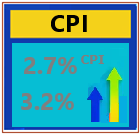
10 Year Treasury Yield
The yield on the benchmark 10-year Treasury note rose 3.5 basis points to 2.031% at around 8:45 a.m. ET. The benchmark 10-year rate, which stood below the 2% level before news of the pull-out of some Russian troops, had climbed above 2% last week following the hottest inflation reading in four decades. The yield on the 30-year Treasury bond traded 2.9 basis points higher at 2.33%. Yields move inversely to prices and a basis point equals 0.01%. Yields moved higher on Monday as St. Louis Fed President James Bullard reiterated his call for the central bank to take aggressive steps to fight inflation in the first half of 2022. Bullard told CNBC that the Fed should “front-load” the tightening of its monetary policy.
PPI - Wholesale Prices
Wholesale prices rise 1% in January, up 9.7% over the past year. Prices at the wholesale level jumped twice the expected level in January as inflation pressures were unabated to start the year, the Labor Department said Tuesday. The producer price index, which measures final-demand goods and services, increased 1% for the month, against the Dow Jones estimate for 0.5%. Over the past 12 months the gauge rose an unadjusted 9.7%, close to a record in data going back to 2010. Excluding food, energy and trade services, co-called core PPI increased 0.9% for the month, well ahead of the 0.4% estimate. For the 12-month period, the measure increased 6.9%. Both core and headline PPI gains over the year were 0.1 percentage point lower than the record levels hit in December 2021. As has been the case through much of the pandemic era, goods prices outweighed those for services, rising 1.3% and 0.7% respectively. The increases come amid burgeoning inflation across the economy, with consumer prices running at a 40-year high. Federal Reserve officials plan to act soon to contain the price increases, with interest rate hikes expected to begin in March and continue throughout the year. Final demand energy prices jumped 2.5% in January, while food rose 1.6%.
The producer price index, which tracks average price changes America's producers get paid for their goods and services over time, rose 9.7% in the 12 months ended in January, not adjusted for seasonal swings, the Bureau of Labor Statistics reported Tuesday. That was far higher than economists had expected. The PPI data series dates back to 2010. For the month of January alone, prices rose 1%, adjusted for seasonal swings, dwarfing both the price increase from December and economists' expectations. Forecasts had only been for a 0.5% price increase.
Empire State Manufacturing Index
Manufacturing activity in New York state barely improved in February from a month earlier, falling short of expectations for a more robust rebound, while a measure of selling prices surged to a record high. The Federal Reserve Bank of New York’s general business conditions index increased to 3.1 from minus 0.7 a month earlier, a report showed Tuesday. Figures below zero indicate contraction, and the median projection in a Bloomberg survey of economists called for a rebound to 12.
Treasury International Capital (TIC)
The U.S. Department of the Treasury today released Treasury International Capital (TIC) data for December 2021. The next release, which will report on data for January 2022, is scheduled for March 15, 2022. The sum total in December of all net foreign acquisitions of long-term securities, short-term U.S. securities, and banking flows was a net TIC outflow of $52.4 billion. Of this, net foreign private outflows were $33.4 billion, and net foreign official outflows were $19.0 billion. Foreign residents increased their holdings of long-term U.S. securities in December; net purchases were $76.9 billion. Net purchases by private foreign investors were $77.5 billion, while net sales by foreign official institutions were $0.6 billion. U.S. residents decreased their holdings of long-term foreign securities, with net sales of $37.6 billion. Taking into account transactions in both foreign and U.S. securities, net foreign purchases of long-term securities were $114.5 billion. After including adjustments, such as estimates of unrecorded principal payments to foreigners on U.S. asset-backed securities, overall net foreign purchases of long-term securities are estimated to have been $101.9 billion in December. Foreign residents increased their holdings of U.S. Treasury bills by $12.0 billion. Foreign resident holdings of all dollar-denominated short-term U.S. securities and other custody liabilities increased by $46.7 billion.Banks’ own net dollar-denominated liabilities to foreign residents decreased by $200.9 billion.
MBA Purchase Applications
Mortgage applications decreased 5.4 percent from one week earlier, according to data from the Mortgage Bankers Association's (MBA) Weekly Mortgage Applications Survey for the week ending February 11, 2022. The Market Composite Index, a measure of mortgage loan application volume, decreased 5.4 percent on a seasonally adjusted basis from one week earlier. On an unadjusted basis, the Index decreased 3 percent compared with the previous week. The Refinance Index decreased 9 percent from the previous week and was 54 percent lower than the same week one year ago. The seasonally adjusted Purchase Index decreased 1 percent from one week earlier. The unadjusted Purchase Index increased 5 percent compared with the previous week and was 7 percent lower than the same week one year ago.
OIL
Oil prices bounced back to $95 a barrel on Wednesday as US and NATO officials say they see no sign of de-escalation on the ground in the Russia-Ukraine standoff.US crude jumped as much as 3.2% to an intraday peak of $95.01 a barrel. This comes after oil prices fell sharply Tuesday after Russian announced it is withdrawing some troops following the completion of recent drills near Ukraine. The rebound reflects lingering concerns about an invasion of Ukraine that threatens to disrupt Russia's vast energy supplies at a time when global supply is already failing to keep up with demand. US oil hit a seven-year high of $95.82 a barrel on Monday on Russia-Ukraine fears. In recent trading, oil was up 2.7% to $94.57 a barrel. Brent crude, the world benchmark, gained 2.6% to $95.75 a barrel.
Retail Sales
Food and drinking establishments, considered a barometer for the pandemic-era economy, saw sales dip 0.9% for the month despite the major escalation in Covid cases fueled by the omicron spread. Even taking into account the December decline, retail sales in recent months have been increasing much faster than prices, so households are purchasing larger volumes of goods and services, not just paying higher prices. On a year-over-year basis, retail sales overall rose 13%, pushed higher by a 33.4% surge in gasoline station sales and a 21.9% burst in clothing stores.
Investors were weighing a stronger-than-expected retail sales report for January. The Commerce Department said sales jump 3.8% last month, though that number is not adjusted for inflation. The sales decline in December was also revised even lower. The numbers came with the economy facing the worst inflation in 40 years, which helps feed into the retail sales numbers. The Federal Reserve is expected to enact multiple interest rate hikes this year to combat rising prices, with markets looking for the central bank to boost its benchmark short-term borrowing rate by half a percentage point in March.
FOMC Minutes for Meeting 25-26/Jan/2022
Meanwhile, the Federal Reserve is due to release the minutes from its January 2022 meeting at 2 p.m. ET on Wednesday. Investors will be poring over the minutes for any further indications of its plans for raising interest rates and tightening monetary policy, amid rising inflation.
The Federal Reserve on Wednesday released the minutes from its Jan. 25-26, 2022 meeting. Following the meeting, the policymaking Federal Open Market Committee said it would not raise interest rates yet but strongly indicated a hike is on the way as soon as March. In addition, the committee set out procedures for how it will start unwinding its nearly $9 trillion balance sheet, which consists largely of bonds it has purchased in an effort to drive down rates and stimulate growth. Since the meeting, fresh inflation readings have shown prices rising at the fastest pace in 40 years. The Fed targets inflation to average around 2%, and officials have conceded that policy needs to get tighter to bring prices down.The minutes showed the Fed is prepared to hike interest rates and reduce its balance sheet soon, as investors had already expected.
Geopolitical Risk
Ongoing tension at the Russia-Ukraine border continued to impact market sentiment..NATO officials on Wednesday accused Russia of increasing troop numbers at the Ukrainian border. U.S. and Russian aircraft in the Mediterranean Sea flew close to each other over the weekend, The Wall Street Journal reported Wednesday.
10 Year Yield
10-year Treasury yield dips after strong retail sales data as investors await Fed minutes. The yield on the benchmark 10-year Treasury note slipped by 1 basis point to 2.031% by around 8:40 a.m. ET. The yield on the 30-year Treasury bond fell by a similar amount 2.338%. Yields move inversely to prices and 1 basis point is equal to 0.01%..
Import and Export Prices
U.S. import prices increased by the most in nearly 11 years in January 2022 amid a jump in the cost of energy products and strained supply chains, the latest indication that high inflation could persist for a while. Import prices increased 2.0% last month, the largest rise since April 2011, after declining 0.4% in December, the Labor Department said on Wednesday. In the 12 months through January, prices accelerated 10.8% after rising 10.2% in December. Economists polled by Reuters had forecast import prices, which exclude tariffs, advancing 1.3%. The report followed news on Tuesday that producer prices increased by the most in eight months in January. Consumer prices also rose solidly last month, with the annual inflation rate posting its largest increase in 40 years.
Nvidia (NVDA)
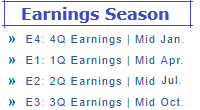
Nvidia reported fourth-quarter earnings and sales on Wednesday that beat analyst expectations and provided a strong outlook for the current quarter. The stock fell about 2% in extended trading.Here’s how the chipmaker did versus Refinitiv consensus expectations for the quarter ending January:
EPS: $1.32, adjusted, versus $1.22 expected, up 69% year-over-year.
Revenue: $7.64 billion, versus $7.42 billion expected, up 53% year-over-year.
Walmart (WM) Earnings
Walmart’s earnings may signal if shoppers are spending or getting spooked by inflation. Walmart will report its fiscal fourth-quarter earnings on Thursday. Along with reporting holiday results, the retail giant may be a bellwether of inflation and indicate whether Americans are starting to spend differently as prices of food and more rise. “The voice of Walmart carries more weight in the context of ‘How healthy is the consumer?’” said Steph Wissink, a retail analyst for Jefferies.
In periods of inflation, shoppers tend to follow a familiar script: Spending more at value retailers. Using coupons and hunting store aisles for discounted items. Trading down to cheaper brands, such as a grocers’ private label. Buying smaller packs. And skipping discretionary items, such as a new shirt or a gallon of ice cream. Walmart has missed out on stock gains over the past year. Shares of the company are down 7% over the past 12 months, lagging behind the 14% gains of the S&P 500 and the 2% gains of an exchange-traded fund for the retail sector, as of Tuesday’s close..
Walmart topped earnings expectations and reiterated its long-term forecast, which calls for adjusted earnings per share growth in the mid single-digits. The big-box retailer is a bellwether of inflation because of its huge store footprint, diverse customer base and heavy emphasis on groceries. The company’s stock has underperformed on Wall Street over the past 12 months.
Walmart topped quarterly earnings estimates on Thursday after shoppers turned to the retailer for groceries and gifts over the holidays and said it’s focused on value as some customers grow nervous about inflation. The company said it’s on track to hit its long-term financial targets, which call for adjusted earnings per share growth in the mid-single digits in the new fiscal year. Growth at that pace is above average analyst forecasts. Shares were up more than 1% in trading Thursday. Here’s what the company reported for the fiscal fourth quarter ended Jan. 31, according to Refinitiv consensus estimates:
Earnings per share: $1.53 adjusted vs. $1.50 expected
Revenue: $152.87 billion vs. $151.53 billion expected.
The retail giant is closely watched as a bellwether of inflation.
Industrial Production
After reporting a modest decrease in U.S. industrial production in the previous month, the Federal Reserve released a report on Wednesday showing production rebounded by much more than anticipated in the month of January. The Fed said industrial production jumped by 1.4 percent in January after edging down by 0.1 percent in December. Economists had expected industrial production to rise by 0.4 percent. The much bigger than expected rebound in industrial production was led by a spike in utilities output, which skyrocketed by 9.9 percent in January after tumbling by 1.8 percent in December.
The Fed also said capacity utilization for the industrial sector rose to 77.6 percent in January from an upwardly revised 76.6 percent in December. Economists had expected capacity utilization to inch up to 76.8 percent from the 76.5 percent originally reported for the previous month. Capacity utilization in the utilities sector surged to 78.1 percent, while capacity utilization in the mining and manufacturing sectors edged up to 79.1 percent and 77.3 percent, respectively..
Business Inventories
U.S. business inventories increased strongly in December 2021, with motor vehicle stocks accelerating, a sign that the worst of the global semiconductor shortage was probably behind. Business inventories increased 2.1% after rising 1.5% in November, the Commerce Department said on Wednesday.
Inventories are a key component of gross domestic product. December's increase was in line with economists' expectations. Inventories shot up 10.5% on a year-on-year basis in December.Retail inventories surged 4.2% in December, instead of 4.4% as estimated in an advance report published last month. That followed a 2.0% increase in November.Motor vehicle inventories accelerated 6.8% as estimated last month. They increased 4.2% in November.
That would suggest the global shortage of semiconductors, which has constrained motor vehicle production, was easing. But that improvement in supply has not been evident in producer inflation data, which showed wholesale motor vehicle and equipment prices increasing a solid 0.7% in January. Retail inventories excluding autos, which go into the calculation of GDP, jumped 3.3%, rather than 3.6% as estimated last month. Inventory investment increased at a seasonally adjusted annualized rate of $173.5 billion in the fourth quarter, the second-largest quarterly increase on record. Most economists see further scope for inventories to rise, noting that inflation-adjusted inventories remain below their pre-pandemic level. Sales-to-inventory ratios are also low. Inventories contributed 4.90 percentage points to the fourth quarter's 6.9% annualized growth pace. Restocking, after three straight quarters during which inventories were drawn down, is supporting manufacturing. Wholesale inventories increased 2.2% in December. Stocks at manufacturers rose 0.3%. Business sales fell 0.7% in December after increasing 1.1% in November. At December's sales pace, it would take 1.29 months for businesses to clear shelves, up from 1.25 months in November.
Jobless Claims
New weekly jobless claims unexpectedly rose last week, ending a three-week streak of improvements. The Labor Department released its latest weekly jobless claims report Thursday at 8:30 a.m. ET. Here were the main metrics from the print compared to consensus estimates compiled by Bloomberg: Initial jobless claims, week ended Feb. 12: 248,000 vs. 218,000 expected and a revised 225,000 during prior week.
Continuing claims, week ended Feb. 5: 1.593 million vs. 1.605 million expected, and a revised 1.619 million during prior weekEven with the rise in filings last week, jobless claims hovered near pre-pandemic levels, given that 2019's weekly average of new claims was approximately 220,000. In February last year, jobless claims were still coming in at a weekly rate of about 800,000 as virus-related pressures weighed on the labor market.Initial jobless claims edged higher in January to near 300,000 around the time that Omicron cases surged to a record level in the U.S. Though the virus-induced impact appeared as a brief bump higher in the weekly jobless claims data, the latest monthly jobs report showed surprising resilience. Non-farm payrolls soaring by a much greater-than-expected 467,000 in January while the labor force participation rate rose more than expected.
Housing Market Index - HMI
Homebuilders’ confidence falls as they wait months for cabinets, garage doors and appliances. Homebuilder confidence fell for the second straight month. Residential construction costs are up 21% year over year.“These delivery delays are raising construction costs and pricing prospective buyers. Supply chain issues for homebuilders appear to be getting worse, and that is weighing on confidence in the industry. Builder confidence in the single-family, newly built housing market fell 1 point in February to 82 on the National Association of Home Builders/Wells Fargo Housing Market Index. That is the second straight month of declines. Anything above 50 is considered positive. The index stood at 84 in February 2021.
Housing Starts
U.S. homebuilding fell more than expected in January as many parts of the country experienced freezing temperatures, but a surge in permits suggested a rebound in the coming months was likely amid a severe shortage of homes on the market.
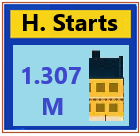
Housing starts dropped 4.1% to a seasonally adjusted annual rate of 1.638 million units last month, the Commerce Department said on Thursday. Data for December was revised slightly up to a rate of 1.708 million units from the previously reported 1.702 million units. Economists polled by Reuters had forecast starts would fall to a rate of 1.700 million units.
Building Permits
Permits for future homebuilding in January rose 0.7% to a rate of 1.899 million units, the highest since 2006.
Existing Home Sales
January home sales jump 6.7% despite a record low supply. Sales of previously owned homes in January rose 6.7% from December to a seasonally adjusted annualized rate of 6.5 million units, according to the National Association of Realtors. The supply of homes for sale fell to a record low, down 16.5% from a year ago. Tight supply and strong demand pushed the median price of a home sold in January to $350,300, an increase of 15.4% from January 2021.
Sales of previously owned homes in January rose 6.7% from December to a seasonally adjusted annualized rate of 6.5 million units, according to the National Association of Realtors. That exceeded Wall Street expectations significantly. Sales were 2.3% lower compared with January 2021. The supply of homes for sale fell to a record low, down 16.5% from a year ago. There were just 860,000 homes for sale at the end of January. At the current sales pace it would take just 1.6 months to exhaust that inventory. A 4 to 6-month supply is considered a balanced market. That is also a record low.
Sales of newly-built homes, which are counted by contracts signed during the month not closings, jumped nearly 12% in December from November. Buyers are turning more to new construction because of the very low supply of existing homes for sale. Unfortunately builders are not keeping up with demand, as supply chain and labor issues slow production.
Philadelphia Fed Manufacturing index
The Philadelphia Federal Reserve said Thursday its gauge of regional business activity fell to 16 from 23.2 in February 2022. Any reading above zero indicates improving conditions. Economists polled by the Wall Street Journal expected a 19 reading. Any reading above zero indicates expansion in the manufacturing sector. The headline index is based on a single stand-alone question about business conditions unlike the national ISM manufacturing index which is a composite based on components.
Leading Indicators
January 2022 Leading Indicators: -0.3% to 119.6 vs. +0.2% consensus and +0.8% prior. A gauge of future U.S. economic activity fell in January for the first time in nearly a year amid a resurgence in COVID-19 cases, high inflation and supply chain disruptions, supporting expectations that growth would slow in the first quarter. The Conference Board said on Friday its Leading Economic Index dropped 0.3% last month, the first decline since February 2021, after increasing 0.7% in December. Economists polled by Reuters had expected the index to rise 0.2%. Gross domestic product estimates for the first quarter are mostly below a 2.0% annualized rate. The economy grew at a 6.9% pace in the fourth quarter.
E-Commerce Sales
E-Commerce Sales Grew 50% to $870 Billion During The Pandemic. The US Department of Commerce Retail Indicator Division, released its’ Quarterly Retail E-Commerce Sales 4th Quarter 2021 report on Friday February 18th, 2022. The report represents the most granular e-commerce category sales data provided by the US Department of Commerce, and is the only view that completely separates e-commerce from other types of non-store sales, such as mail-order. For the first time, the report is now a standard data product, having previously been an experimental release.
E-Commerce sales were $870 billion in the US in 2021, a 14.2% increase over 2020 and a 50.5% increase over 2019. E-Commerce represented 13.2% of all retail sales in 2021 in the US. The fastest growth category of e-commerce sales over the past two years were furniture, building materials, and electronics which cumulatively grew more than 200% since 2019. Food and beverage e-commerce grew 170%, representing 9.6% of all grocery sales in 2021 according to eMarketer. Apparel was one of the few categories of e-commerce to grow slower than the industry average at 39%.. |