10-Year Treasury Yield
U.S. Treasury yields rose Monday as investors continue to monitor the outlook for inflation and the economy. The yield on the 2-year note yield reached its highest level since July 2007, last trading up about 3 basis points at 4.83%. The yield on the benchmark 10-year Treasury note was up slightly at 3.953%. Yields move inversely to prices.
Durable Orders
New orders for key U.S.-manufactured capital goods increased more than expected in January while shipments of those so-called core goods rebounded, suggesting that business spending on equipment picked up at the start of the first quarter. Orders for non-defense capital goods excluding aircraft, a closely watched proxy for business spending plans, rose 0.8% last month, the Commerce Department said on Monday. These core capital goods orders dropped 0.3% in December. Economists polled by Reuters had forecast core capital goods orders edging up 0.1%. Core capital goods orders increased 5.3% on a year-on-year basis in January. The surge in orders is at odds with business surveys that have suggested manufacturing, which accounts for 11.3% of the U.S. economy, was in recession. Business sentiment soured as the Federal Reserve aggressively raised interest rates. But demand for goods, which are typically bought on credit, continues to hold up.
Pending Home Sales
A sharp drop in mortgage interest rates brought homebuyers out in force in January, but rates have bounced back higher again, so the gains may be short-lived. Signed contracts on existing homes jumped 8.1% last month compared with December, according to the National Association of Realtors. That’s the second straight month of gains. Sales, however, were still 24% lower compared with January 2022. The so-called “pending sales” are the most current indicator of housing demand, as it can take up to two months to close on a signed sale. Closed sales in January were lower, because they were based on contracts signed in November and December, when mortgage rates were higher. And January’s jump is all about mortgage rates. After hitting a high of just over 7.3% in October, which caused sales to plummet, the average rate on the popular 30-year fixed mortgage dropped back close to 6% in January, according to Mortgage News Daily. But mortgage rates moved higher again in February, and the average rate stood at 6.88% as of Friday. Sales activity is already likely slowing. Mortgage applications to buy a home, which are a weekly indicator of buyer demand, have been falling for much of February.
Intal Trade Goods
U.S. goods trade deficit widens in January; wholesale inventories declineThe U.S. trade deficit in goods increased moderately in January, with both imports and exports rising solidly, leaving trade on track to have little or no impact on gross domestic product growth early in the first quarter.The goods trade deficit widened 2.0% to $91.5 billion, the Commerce Department said on Tuesday. This left the goods trade deficit slightly above the fourth-quarter average. Goods imports increased 3.4% to $265.3 billion. Motor vehicle imports surged 9.0% while imports of consumer goods jumped 6.4%. There were also increases in imports of food and capital goods. But imports of industrial supplies, which include crude oil, fell as did those of other goods. Exports of goods shot up 4.2% to $173.8 billion, boosted by a 14.8% jump in consumer goods. Motor vehicle exports accelerated 8.2%. Exports of capital goods and food also increased strongly. Shipments of industrial supplies, however, rose moderately and exports of other goods fell. A smaller trade deficit was one of the contributors to the economy's 2.7% annualized growth pace in the fourth quarter. The other boost to growth came from inventories..
Retail Inventories (Advance)
Retail inventories advance 0.3% in first month of 2023. January Retail Inventories (Advance) +0.3% to $743.1B vs. +0.1% prior (revised from +0.4%). On a Y/Y basis, retail inventories climbed 12.0% in January. The November to December percentage change was revised to +0.4% from +0.7%.
Wholesale Inventories (Advance)
The so-called advance indicators report from the Commerce Department on Tuesday also showed wholesale inventories falling 0.4% last month after gaining 0.1% in December, reflecting drops in both durable and nondurable goods. Stocks at retailers rose 0.3% after increasing 0.4% in December. Motor vehicle inventories climbed 0.6% after advancing 1.4% in December. Excluding motor vehicles, retail inventories rose 0.2% after gaining 0.1% in December. This component goes into the calculation of GDP. Growth estimates for the first quarter are currently as high as a 2.8% annualized rate, largely thanks to strong consumer spending and factory production.
Case-Shiller Home Price Index
Home price gains weakened sharply to end 2022, according to S&P Case-Shiller.Higher mortgage rates weighed on home price gains in December. Home prices in December were 5.8% higher than the previous December, according to S&P Case-Shiller. That’s down from a 7.6% annual gain in November. Prices are now 4.4% below their June peak.U.S. single-family home prices in December increased at their slowest pace since the summer of 2020, surveys showed on Tuesday, but tight supply could limit an anticipated decline in house prices. The S&P CoreLogic Case Shiller national home price index, covering all nine U.S. census divisions, increased 5.8% year-on-year in December. That was the smallest annual gain since mid-2020 and followed a 7.6% rise in November. Prices increased 5.8% in 2022, pulling back from 2021's record-setting 18.9% gain. Though there are signs the housing market is stabilizing, with pending home sales rising by the most in more than 2-1/2 years in January and new home sales hitting a 10-month high, it will be a while before it turns around. Mortgage rates have resumed their ascent after robust consumer spending and labor market data as well as strong monthly inflation readings raised the prospect of the U.S. central bank hiking interest rates into the summer. The 30-year fixed mortgage rate increased to an average of 6.50% last week from 6.32% in the prior week, according to data from mortgage finance agency Freddie Mac. The third straight weekly increase lifted the rate to a three-month high.
FHFA House Price Index
A separate report from the Federal Housing Finance Agency on Tuesday showed home prices advanced 6.6% in the 12 months through December, the smallest rise since June 2020, after increasing 8.2% in November. They increased 6.6% in 2022 compared to a gain of 18.0% in 2021. While higher mortgage are hurting demand and cooling house price inflation, the FHFA noted that "these negative pressures were partially offset by historically low inventory."
Chicago PMI
Chicago PMI unexpectedly falls in February. February Chicago PMI: 43.6 vs 45.0 consensus and 44.3 in January. The latest reading is the lowest since November 2022 and marks the sixth straight month of contractionary business activity. Earlier, trade in goods deficit swelled more than expected in January
Consumer Confidence
U.S. consumer confidence declined again in February, with the decrease concentrated among households making an annual income of $35,000 or more, though Americans grew more upbeat about the labor market, a survey showed on Tuesday. The Conference Board said its consumer confidence index slipped to 102.9 this month from 106.0 in January. Economists polled by Reuters had forecast the index at 108.5. The survey places more emphasis on the labor market, which remains tight. "The decrease reflected large drops in confidence for households aged 35 to 54 and for households earning $35,000 or more," said Ataman Ozyildirim, senior director of Economics at The Conference Board. The share of consumer viewing jobs as "plentiful" increased back to levels seen in the spring of last year. Consumers' 12-month inflation expectations fell to 6.3% from 6.7% last month.
MBA Purchase Applications
Applications to refinance a home loan dropped 6% for the week and were 74% lower year over year. Mortgage rates moved higher again last week, pushing buyers back to the sidelines just as the spring housing market is supposed to be heating up. Mortgage applications to purchase a home dropped 6% last week compared with the previous week, according to the Mortgage Bankers Association’s seasonally adjusted index. Volume was 44% lower than the same week one year ago, and is now sitting at a 28-year low. This as the average contract interest rate for 30-year fixed-rate mortgages with conforming loan balances ($726,200 or less) increased to 6.71% from 6.62%, with points increasing to 0.77 from 0.75 (including the origination fee) for loans with a 20% down payment. That is the highest rate since November of last year. Refinance applications account for less than a third of all applications and remained more than 70% behind last year’s pace, as a majority of homeowners are already locked into lower rates..
PMI Manufacturing Final
February S&P Global US Final Manufacturing PMI 47.3 Vs. Unrevised 47.8 Expected, January 46.9. US manufacturing remained under intense pressure in February. Although the PMI rose slightly, it continues to signal the steepest downturn outside of pandemic lockdown months since 2009. “Moreover, some of the improvement in output could merely be attributed to faster supplier delivery times, which quickened to the greatest extent since 2009 to facilitate higher production and enable factories to work through previously placed orders. The worry is that new order inflows continue to fall sharply as many companies report disappointing sales, linked in part to a sustained trend towards cost-saving inventory reduction and low levels of confidence at their customers, both at home and abroad. None of this points to a healthy economic situation
ISM Manufacturing Index
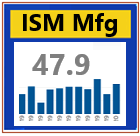
The ISM survey's measure of prices paid by manufacturers rebounded to 51.3 in February from 44.5 in January, breaking above the 50 mark for the first time in five months.The ISM's manufacturing PMI edged up to 47.7 last month from 47.4 in January. The small rise was the first in six months. Economists polled by Reuters had forecast the index would increase to 48.0. A PMI reading below 50 indicates contraction in manufacturing, which accounts for 11.3% of the U.S. economy. U.S. manufacturing contracted for a fourth straight month in February, but there were signs that factory activity was starting to stabilize, with a measure of new orders pulling back from a more than 2-1/2-year low. The Institute for Supply Management survey on Wednesday also showed prices for raw materials increasing last month, which the ISM partly attributed to "a return to more balanced supplier-buyer relationships, as sellers are more interested in filling order books and buyers now see the need to reorder." The survey also hinted at buyer resistance to higher prices. Nevertheless, the rebound in prices at the factory gate suggests inflation could remain elevated for a while after monthly consumer and producer prices surged in January.
Construction Spending
Other data from the Commerce Department showed construction spending dipping 0.1% in January as investment in single-family homebuilding continued to decline. The housing market has been hammered by the Fed's aggressive monetary policy tightening. U.S. construction spending unexpectedly fell in January as investment in single-family homebuilding continued to decline. The Commerce Department said on Wednesday that construction spending dipped 0.1% in January after dropping 0.7% in December. Economists polled by Reuters had forecast construction spending rising 0.2%. Construction spending increased 5.7% on a year-on-year basis in January. Spending on private construction projects was unchanged after decreasing 0.8% in December. Investment in residential construction fell 0.6%, with spending on single-family housing projects dropping 1.7%. Outlays on multi-family housing projects rose 0.4%, boosted by strong demand for rental housing. The housing market has been hammered by the Federal Reserve's aggressive monetary policy tightening, with residential investment contracting for seven straight quarters, the longest such stretch since 2009.
Jobless Claims
mmmm
Productivity and Costs
US fourth-quarter labor costs revised higher; productivity growth lowered. U.S. labor costs grew faster than initially thought in the fourth quarter, though the pace has slowed from the prior quarters. Unit labor costs – the price of labor per single unit of output – accelerated at a 3.2% annualized rate last quarter, the Labor Department said on Thursday. That was revised up from the 1.1% pace reported last month. With labor costs revised higher, growth in nonfarm productivity, which measures hourly output per worker, was downgraded to a 1.7% rate from the previously reported 3.0% pace in the fourth quarter. Economists forecast productivity growth being lowered to a 2.6% rate.
PMI Composite Final
The S&P Global US Composite PMI stood at 50.1 in February 2023, little-changed from a preliminary estimate of 50.2 and well above January's 46.8. The latest data signaled an end to a seven-month sequence of contraction and indicated broadly stable levels of business activity at private sector firms. New orders declined the least in four months, while the rate of job creation accelerated to a five-month high and backlogs of work fell for a fifth month running. On the price front, input costs rose at the second-slowest pace since October 2020. Nonetheless, output charges increased at a steeper pace, as firms sought to pass through higher cost burdens to their customers.
ISM Services Index
mmmm
Fixed Mortgage Rates
Mortgage rates jump back over 7% as inflation fears drive yields higher. The average rate on the 30-year fixed mortgage jumped back over 7% Thursday, rising to 7.1%, according to Mortgage News Daily. Growing fears that inflation is not cooling off are pushing bond yields higher. Mortgage rates loosely follow the yield on the U.S. 10-year Treasury. While the trajectory for rates now appears to be higher again, it is not necessarily guaranteed for the long term.Growing fears that inflation is not cooling off are pushing bond yields higher. Mortgage rates loosely follow the yield on the U.S. 10-year Treasury.
|