10-Year Treasury Yield
U.S. Treasury yields moved lower on Monday as investors look ahead to several economic releases this week including a key jobs report. The 10-year Treasury yield was lower by more than 4 basis points to 4.145%, while the 2-year Treasury yield was lower by less than 2 basis points at 3.635%. The 30-year Treasury yield slid more than 5 basis points to 4.711%.
Pending Home Sales
US pending home sales rebound in August 2025 to 74.7 amid low mortgage rates. Sales of previously owned U.S. homes increased solidly in August 2025 as lower mortgage rates pulled buyers back into the market, though a softening labor market could curb further gains. The National Association of Realtors said on Monday pending home sales, based on signed contracts, rebounded 4.0% last month. Economists polled by Reuters had forecast contracts, which become sales after a month or two, rising 0.2%.
US Dollar Index
The dollar slid against major currencies such as the euro and yen on Monday following a rally last week after stronger-than-expected U.S. economic data and ahead of a key nonfarm payrolls report that could offer further clues on the Federal Reserve's policy path. Data on housing, durable goods, and revisions to the second quarter gross domestic product came out higher than forecast. In addition, U.S. jobless claims fell sharply. The economic reports prompted a pullback in expectations for Fed interest rate cuts.
Case Shiller Index
US Home Price Growth Slows Further: Case-Shiller. Home prices declined in July as the benchmark national index fell for a fifth straight month. The seasonally adjusted home prices for the national index saw a 0.1% decrease month-over-month and a 1.7% increase year-over-year. This marks the sixth straight month annual gains have slowed and is the smallest annual increase since July 2023. After adjusting for inflation, the monthly change fell to -0.3% and annual change fell to -2.3%. Home Prices Fall for Fifth Straight Month.
FHFA Index
U.S. house prices fell 0.1 percent in July, according to the U.S. Federal Housing (FHFA) seasonally adjusted monthly House Price Index (FHFA HPI®). House prices rose 2.3 percent from July 2024 to July 2025. The previously reported 0.2 percent price decline in June remained unchanged. For the nine census divisions, seasonally adjusted monthly home price changes ranged from -1.2 percent in the Middle Atlantic division to +0.3 percent in the East North Central division. The 12- month changes were all positive, ranging from +0.2 percent in the Pacific division to +5.1 percent in the Middle Atlantic division.
Chicago PMI
The Chicago Purchasing Managers’ Index (PMI), a key indicator of the economic health of the manufacturing sector in the Chicago region, has reported a lower than expected reading. The actual figure came in at 40.6, falling short of the forecasted 43.4. The Chicago PMI is a significant economic indicator, with a reading above 50 signaling an expansion of the manufacturing sector, and a reading below 50 indicating contraction. The latest reading of 40.6, therefore, suggests a contraction in the manufacturing sector in the Chicago region.
Consumer Confidence
Consumer confidence edged lower in September ahead of an expected data blackout caused by the looming federal government shutdown, the Conference Board reported Tuesday. The board’s headline confidence index registered a 94.2 reading, off 3.6 points from the August reading and below the Dow Jones estimate for 96.0. The reading was the lowest since April and comes with nonessential government operations slated to close at midnight.
JOLTS Though the labor market has shown considerable weakness this year, employment availability in August was slightly better than the prior month. The Bureau of Labor Statistics, in what could be its last data release until the spending impasse on Capitol Hill is resolved, said job openings totaled 7.23 million, up 19,000 from July though down 422,000, or 5.5%, from the same period a year ago.The bureau’s Job Openings and Labor Statistics report, which Federal Reserve officials watch closely to gauge labor market slack, showed a slower pace in both hiring and total separations. Quits fell by 75,000 for a category looked at as a gauge of worker confidence for finding new jobs after leaving their present one.
Crypto World Bitcoin
Major cryptocurrencies rise after private payrolls saw their biggest decline in more than two years during September, a further sign of labor market weakening that amplifies the data blackout accompanying the U.S. government shutdown. Plus, Blockchain Association CEO Summer Mersinger discusses a letter the association sent to Congressional leaders defending the GENIUS Act stablecoin bill, which was signed into law in July.
MBA Mortage Applications
The Market Composite Index, a measure of mortgage loan application volume, decreased 12.7% on a seasonally adjusted basis from one week earlier. On an unadjusted basis, the Index decreased 13% compared with the previous week. The Refinance Index decreased 21% from the previous week and was 16% higher than the same week one year ago. The seasonally adjusted Purchase Index decreased 1% from one week earlier. The unadjusted Purchase Index decreased 2% compared with the previous week and was 16% higher than the same week one year ago.Mortgage rates increased to their highest level in three weeks as Treasury yields pushed higher on recent, stronger than expected economic data.
ADP Employment Report
ADP National Employment Report: Private Sector Employment Shed 32,000 Jobs in September; Annual Pay was Up 4.5%. ADP released its September 2025 National Employment Report, revealing that private sector employment declined by 32,000 jobs, while annual pay increased by 4.5% for job-stayers. The report, based on payroll data from over 26 million U.S. private-sector employees, showed job-changers' pay growth slowed to 6.6% from 7.1% in August.
PMI Mfg Final
US September final S&P Global manufacturing PMI 52.0 vs 52.0 preliminary. he final US reading on manufacturing from S&P Global for September 2025.A growing uncertainty, however, relates to supply chains, with September seeing an increase in tariff- related vendor delays, which threaten to curb production and push up prices if these difficulties persist or intensify.
ISM Mfg Index
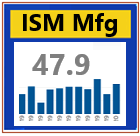
The Institute for Supply Management (ISM) Manufacturing Index (PMI) for September 2025 came in at 49.1, up from 48.7 in August, but still indicating contraction in the manufacturing sector for the seventh consecutive month. This reading was slightly above the market expectation of 49.0. While the overall index shows contraction (a reading below 50), the production index rose to 51.0, and new orders fell to 48.9, indicating mixed results within the sector. September 2025 Reading: 49.1, an increase from August's 48.7. Expectations: The 49.1 reading was slightly better than the 49.0 expected by the market. Trend: This marks the seventh straight month of contraction for the manufacturing sector.
Construction Spending
Delayed due to the government shut down,
EIA Crude Oil Report
EIA: US crude inventories up 1.8 million bbl as federal government shutdown begins Release of the data Oct. 1 coincided with the first day of a shutdown of the federal government. EIA said it “will be able to operate for a period of time during the lapse in appropriations.” US crude oil inventories for the week ended Sept. 26, excluding the Strategic Petroleum Reserve, increased by 1.8 million bbl from the previous week, according to data from the US Energy Information Administration (EIA).
Hedging Gold
Gold is up nearly 2% on the day again to $3,485 currently and looks extremely poised to touch $3,500 this week next. Just like it is tough to pick a bottom in falling market, it is tough to pick a top in this situation for gold. Not least when so many factors are all running in sync to underpin the precious metal, all at once.
Jobless Initial Claims
Delayed due to the government shut down,
Factory Orders
Delayed due to the government shut down,
Fed Balance Sheet
Since the peak of its balance sheet in April 2022, the Fed’s QT has shed $2.38 trillion, or 26.5% of its total assets. In terms of the Pandemic-era QE, the Fed has shed 49.5% of the $4.81 trillion it had piled on from March 2020 through April 2022. Total assets on the Fed’s balance sheet declined by $15 billion in September, to $6.59 trillion. This $15 billion decline was a mix of $24 billion of declines and $9 billion of increases. The Fed's balance sheet is continuing to shrink due to Quantitative Tightening (QT), though the pace slowed in June 2025. In September 2025, the Fed shed another $15 billion in assets, bringing the total reduction since its peak to $2.38 trillion. A key development is the decline in bank reserves, falling below $3 trillion for the first time since January 2025, which could influence the Fed's decision on when to stop QT and is a significant indicator that the system is approaching an "ample" level of reserves.
Mortgage Rates
The average contract interest rate for 30-year fixed-rate mortgages with conforming loan balances ($806,500 or less) increased to 6.46% from 6.34%, with points increasing to 0.61 from 0.57 (including the origination fee) for 80% loan-to-value ratio (LTV) loans. The effective rate increased from last week.
Non Farm Payroll
Delayed due to the government shut down, September jobs report is a blank page The monthly jobs report, along with other closely watched economic data, won't get collected or reported during the shutdown.The government shutdown precluded Friday’s release of the monthly jobs report while putting other important federal data gathering and reporting on hold. The monthly employment report from the Bureau of Labor Statistics, a key gauge of economic health closely watched by investors and policymakers, wasn’t released as scheduled this morning, leaving unanswered questions about the health of the US labor market. The longer the shutdown stretches on, the bigger deal it will be for those awaiting the official jobs data, notably the Federal Reserve. Meanwhile, the shutdown could also delay the release of September’s inflation data, set to be announced Oct. 15, as well as the subsequent 2026 cost-of-living adjustment for Social Security benefits. October’s jobs data and inflation data, scheduled to be published Nov. 6 and Nov. 10, respectively, could also be pushed back if collection efforts are hampered by the shutdown.
PMI Services Final
The S&P Global US Composite PMI for September 2025 was released with a final reading of 54.2, indicating a continuation of economic expansion. This figure represents a slight decrease from the previous month's reading of 54.5 and is higher than the preliminary estimate. The overall composite index combines manufacturing and services sector data to provide a broader view of the U.S. private sector economy.
ISM Services Index
The latest ISM Services Index for September 2025 showed mixed results, with the overall Services PMI at 50% (indicating no expansion or contraction), while New Orders at 50.4% showed slight growth and the Employment Index contracted at 47.2%. This indicates mixed activity in the U.S. services sector, with new business picking up but job growth slowing.
|