PMI Composite Flash
January U.S. PMI composite flash index jumps more than expected. Fri, Jan. 22, 2021 January U.S. PMI Composite Flash: 58.0 vs. 55.5 consensus and 55.3 prior (revised from 55.7). Services PMI: 57.5 vs. 53.8 consensus, 54.8 prior (revised from 55.3). Manufacturing PMI rises to 59.1 vs. 57.1 in December, a series record high.
Treasury International Capital (TIC)
The U.S. Department of the Treasury today released Treasury International Capital (TIC) data for November 2020. The next release, which will report on data for December 2020, is scheduled for February 16, 2021. The sum total in November of all net foreign acquisitions of long-term securities, short-term U.S. securities, and banking flows was a net TIC inflow of $214.1 billion. Of this, net foreign private inflows were $233.5 billion, and net foreign official outflows were $19.3 billion. Foreign residents increased their holdings of long-term U.S. securities in November; net purchases were $125.8 billion. Net purchases by private foreign investors were $112.5 billion, while net purchases by foreign official institutions were $13.3 billion. U.S. residents decreased their holdings of long-term foreign securities, with net sales of $23.3 billion. Taking into account transactions in both foreign and U.S. securities, net foreign purchases of long-term securities were $149.2 billion. After including adjustments, such as estimates of unrecorded principal payments to foreigners on U.S. asset-backed securities, overall net foreign purchases of long-term securities are estimated to have been $113.3 billion in November. Foreign residents increased their holdings of U.S. Treasury bills by $13.0 billion. Foreign resident holdings of all dollar-denominated short-term U.S. securities and other custody liabilities increased by $78.6 billion. Banks’ own net dollar-denominated liabilities to foreign residents increased by $22.2 billion.
Philadelphia Fed Manufacturing Index
In January 2021, the Philly Fed Manufacturing Business Outlook Survey indicated manufacturing activity in the region continued to grow, with the current indicator for general activity rising 17.4 points to a solid 26.5. The survey’s current indicators for new orders and shipments increased notably this month and remained positive for the eighth consecutive month. The survey’s future indexes remained at high readings (up 9.7 points to 52.8) and continue to indicate that firms expect growth over the next six months.
Jobless Claims
Americans continued to hit the unemployment line in large numbers as the ongoing surge of Covid cases added to America’s unemployment problem last week. Jobless claims totaled 900,000 for the week ended Jan. 16, the Labor Department reported Thursday. That was slightly less than the Dow Jones estimate of 925,000 and below the previous week’s downwardly revised total of 926,000.
Housing Starts
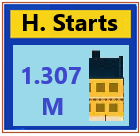
Housing starts jumped 5.8% to a seasonally adjusted annual rate of 1.669 million units last month, the Commerce Department said on Thursday. Economists polled by Reuters had forecast starts would rise to a rate of 1.560 million units in December. Homebuilding increased 5.2% on a year-on-year basis. Starts totaled 1.380 million in 2020, up 7.0% from 2019.
Building Permits
U.S. homebuilding and permits surged in December as historically low mortgage rates supported the housing market, but momentum could slow amid surging lumber prices and a shortage of labor. Permits for future homebuilding accelerated 4.5% to a rate of 1.709 million units in December. Permits, which typically lead starts by one to two months, totaled 1.452 million last year, a 4.8% increase from 2019.
Housing Market Index - HMI
Spike in lumber and land prices causes homebuilder confidence to fall from epic high. Builder confidence in the market for single-family homes fell 3 points in January to 83, according to the NAHB/Wells Fargo Housing Market Index. Anything above 50 is considered positive. Of the index’s three components, current sales conditions dropped 2 points to 90. Sales expectations in the next six months fell 2 points to 83 and buyer traffic fell 5 points to 68. Just two months ago, homebuilders had never been happier. Buyer demand, driven by the pandemic-induced desire for larger newer homes in the suburbs, had homebuilder sentiment at an all-time high. Now the rising cost of getting homes built is making builders less optimistic.
Builder confidence in the market for single-family homes fell 3 points in January to 83, according to the NAHB/Wells Fargo Housing Market Index. Anything above 50 is considered positive. Two months ago, the index hit a record high of 90. In January 2019, before the pandemic struck, it was at 75.
Existing Home Sales
December 2020 Existing Home Sales Annual Pace Rises to 6.76 Million. NAR released a summary of existing-home sales data showing that housing market activity this December rose modestly 0.7% from November 2020. December’s existing-home sales reached a 6.76 million seasonally adjusted annual rate, and rose 22.2% from December 2019. The pandemic took some steam out of a typically busy first quarter in 2020, then robust sales followed to close out the year. Total existing-home sales rose to 5.64 million in 2020, up 5.6% from the prior year, with all regions showing sales gains. The annual sales figure is the highest level since 2006 when existing home sales totaled 6.477 million |