Housing Market Index - HMI
U.S. homebuilders are happy with buyer demand, but higher construction costs are starting to eat away at their confidence. A monthly sentiment index dropped 1 point to 80 in July. The index was at a record high of 90 in November. Anything above 50 is considered positive. Of the index’s three components, current sales conditions fell 1 point to 86. Buyer traffic declined 6 points to 65, and sales expectations in the next six months rose 2 points to 81.
Housing Starts
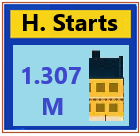
U.S. homebuilding increased more than expected in June, though expensive lumber, as well as shortages of labor and land, continued to constrain builders’ ability to fully take advantage of robust demand for housing. Housing starts rose 6.3% to a seasonally adjusted annual rate of 1.643 million units last month, the Commerce Department said on Tuesday. Data for May was revised down to a rate of 1.546 million units from the previously reported 1.572 million units. Economists polled by Reuters had forecast starts rising to a rate of 1.590 million units. Despite last month’s increase, starts remained below March’s rate of 1.725 million units, which was the highest level since June 2006.
Housing Permits
Permits for future homebuilding fell 5.1% to a rate of 1.598 million units in June. Demand for housing is being driven by low interest rates and a migration from cities in search of spacious accommodations in the suburbs and other low-density areas for home offices and schooling during the COVID-19 pandemic. But that tailwind is gradually fading as vaccinations allow companies to recall workers back to offices in city centers.
Mortgage Applications
mm
Jobless
Weekly jobless claims unexpected moved higher last week despite hopes that the U.S. labor market is poised for a strong recovery heading into the fall. Initial filings for unemployment insurance totaled 419,000 for the week ended July 17, well above the 350,000 Dow Jones estimate and more than the upwardly revised 368,000 from the previous period, the Labor Department reported Thursday. The news sent stock market futures off their highs for the morning, with Wall Street pointing to a slightly negative open. Government bond yields also edged lower. The jobless total was the highest weekly count since May 15 and came amid expectations that the jobs picture will improve markedly as enhanced unemployment benefits end and companies get more aggressive about filling vacant positions. On the positive side, continuing claims, which run a week behind the headline number, declined by 29,000 to 3.24 million, a fresh pandemic low. The total was last higher on March 14, 2020, just after the Covid-19 pandemic declaration and as governments across the U.S. ordered businesses to close, sending more than 22 million to the unemployment line.
Existing Home Sales
After four straight months of declines, sales of previously owned homes rose 1.4% in June month-to-month to a seasonally adjust annualized rate of 5.86 million units, according to the National Association of Realtors. These sales represent closings, so they are based on contracts signed in April and May. Sales were 22.9% higher compared with June 2020. That annual comparison, according to the Realtors, is still slightly skewed due to pandemic lockdowns in certain parts of the country that lasted into summer last year. The inventory of homes for sale at the end of June was 1.25 million, representing a 2.6-month supply at the current sales pace. That is a slight improvement from May’s 2.5-month supply.“We may have turned a corner on inventory,” said Lawrence Yun, NAR’s chief economist. “There is some softening in the demand.”
The Chicago Fed National Activity Index (CFNAI)
US Chicago Fed National Activity Index Falls in June. The Chicago Fed National Activity Index went down to 0.09 in June of 2021 from a downwardly revised 0.26 in May. Production-related indicators contributed +0.01, down from +0.26 in May. The contribution of the employment, unemployment, and hours category moved down to +0.09 from +0.15. Meantime, the personal consumption and housing category contributed -0.08, up slightly from -0.11; and the contribution of the sales, orders, and inventories category increased to +0.06 from -0.04. The index’s three-month moving average declined to +0.06 from +0.80.
Empire
mmm
Business Inventories
mmmmmm
Consumer Sentiment
mmm
Leading Indicators
The Conference Board Leading Economic Index (LEI) for the U.S. increased by 0.7 percent in June 2021 to 115.1 (2016 = 100), following a 1.2 percent increase in May and a 1.3 percent increase in April. June’s gain in the U.S. LEI was broad-based and, despite negative contributions from housing permits and average workweek, suggests that strong economic growth will continue in the near term,” said Ataman Ozyildirim, Senior Director of Economic Research at The Conference Board. “While month-over-month growth slowed somewhat in June, the LEI’s overall upward trend—which started with the end of the pandemic-induced recession in April 2020—accelerated further in Q2. The Conference Board still forecasts year-over-year real GDP growth of 6.6 percent for 2021 and a healthy 3.8 percent for 2022.
|