10-Year Treasury Yield
U.S. Treasury yields continued to climb higher on Wednesday as investors digested the previous session’s dramatic market route triggered by a hot inflation reading. Meanwhile, the yield on the benchmark 10-year Treasury note was up just over one basis point, trading at 3.439%. The yield on the 30-year Treasury bond was up just over half of a basis point at 3.517%.
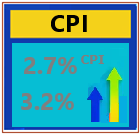
CPI The Dow sank more than 1,200 points Tuesday, or nearly 4%, while the S&P 500 lost 4.3%. The Nasdaq Composite dropped 5.2%. The market moves came after August’s consumer price index report showed headline inflation rose 0.1% on a monthly basis despite a drop in gas prices. The hot inflation report left questions over whether stocks could go back to their June lows or fall even further. It also spurred some fears that the Federal Reserve could potentially hike even higher than the 75 basis points markets are pricing in. Inflation rose 0.1% in August even with sharp drop in gas prices. The consumer price index increased 0.1% in August. Excluding food and energy, the inflation gauge rose 0.6%, both higher than expected. Costs were driven by increases in food, shelter and medical care services, offsetting a sharp decline in gasoline prices. Real average hourly earnings adjusted for inflation rose 0.2% for the month. However, they remained down 2.8% from a year ago. Inflation rose more than expected in August as rising shelter and food costs offset a drop in gas prices, the Bureau of Labor Statistics reported Tuesday. The consumer price index, which tracks a broad swath of goods and services, increased 0.1% for the month and 8.3% over the past year. Excluding volatile food and energy costs, CPI rose 0.6% from July and 6.3% from the same month in 2021.
Treasury Budget
The U.S. government posted a $220 billion budget deficit for August, up 29% from the $171 billion gap reported in the same month last year, as spending on health services, education and interest on the public debt outstripped a double-digit increase in revenues, the Treasury Department said on Tuesday. The Treasury said that receipts in August grew by $35 billion, or 13%, from a year earlier to $304 billion, with a $25 billion, or 11%, increase in individual income tax withholdings accounting for most of the gain. But outlays climbed by $84 billion, or 19%, to $523 billion, leading to only the second year-over-year increase in the federal deficit so far in fiscal 2022, which ends on Sept. 30. The other year-over-year increase occurred in November 2021. The year-over-year spending increase last month was led by a $50 billion, or 153%, spike in outlays for Medicare, the health insurance program for the elderly, and a $19 billion, or 127%, jump in education spending. A $30 billion, or 53%, increase in interest on Treasury securities reflects the interest rate increases that have accelerated this year as the Federal Reserve has fought to contain the highest inflation in four decades. For the first 11 months of fiscal 2022, the deficit fell 65% to $946 billion from $2.71 trillion in the prior-year period, which contained the bulk of the spending from President Joe Biden's $1.9 trillion American Rescue Plan Act.
MBA Purchase Applications
mmmmm
Empire State Mfg Indx
New York Fed manufacturing index in negative territory despite September rebound. Firms not very optimistic that business conditions would improve over next 6 months, says Federal Reserve Bank of New York. The New York Fed manufacturing index rebounded in September, but still remains in negative territory, according to a report released by the Federal Reserve Bank of New York on Thursday. The Empire State Manufacturing Index, which measures the level of general business conditions in the state of New York, climbed 30 points to minus 1.5 in September. The index stood at minus 31.30 in August, the lowest reading since May 2020 and the second-largest monthly decline on record.
Title 9
mmmm
Title 10
mmmm.
Title 11
mmmm
Jobless Claims
mmmm
Title 12
mmmm
Consumer Sentiment
Consumer sentiment comes in slightly below expectations The University of Michigan’s consumer sentiment index preliminary September reading came in at 59.5, just below a Dow Jones estimate of 60. That print was still slightly above August’s final reading of 58.2. “With continued declines in energy prices, the median expected year-ahead inflation rate declined to 4.6%, the lowest reading since last September,” Surveys of Consumers director Joanne Hsu wrote. “However, it is unclear if these improvements will persist, as consumers continued to exhibit substantial uncertainty over the future trajectory of prices.” “Uncertainty over short-run inflation reached levels last seen in 1982, and uncertainty over long run inflation rose from 3.9 to 4.5 this month, well above the 3.4 level seen last September,” Hsu added.
Fedex (FDX) - Transportaion Stocks
FedEx shares sink after company cites weakening global demand. FedEx shares were down 21% Friday morning. The company had announced significant cost-cutting measures following what it called softness in global volume of shipments. The company will close 90 offices and five corporate locations and defer hiring. FedEx warning could be one of many negative earnings revisions FedEx’s warning about its business could be just one of many earnings estimate downgrades from companies and Wall Street analysts in the coming months. FedEx guidance cut drags down rivals FedEx’s guidance cut appears to be weighing on related stocks on Friday morning. Shares of shipping rival UPS fell more than 7% in premarket trading. XPO Logistics dropped 6%. Transport stocks are often seen as a bellwether for the U.S. economy, so FedEx’s warning could create selling pressure across the board on Wall Street as investors prepare for a potential recession.
Shares of FedEx plunged 21.4%, their worst daily drop ever, after the shipments company withdrew its full-year guidance and said it will implement cost-cutting initiatives to contend with soft global shipment volumes as the global economy “significantly worsened.”Transport stocks are typically seen as a leading indicator for the stock market as well as the economy, and FedEx pointed to weakness in Asia as one of the main reasons for its negative outlook. Shares of shipping rivals UPS and XPO Logistics dropped about 4.5% and 4.7%, respectively, and Amazon’s stock fell 2.1%.
Markets selling off on triple witching day
Friday’s sell-off is taking place on a “triple witching” day, which means there could be heightened market volatility as the end of the session draws nearer. On triple witching days, options on stocks, stock indexes, and stock futures expire at the same time. these events take place four times a year and are associated with choppy trading action and high volumes
Worst week since June for S&P 500
S&P 500 has closed below its 200-day for the longest time since the Financial Crisis. The S&P 500 has continuously closed below its 200-day moving average since April 8, the longest such stretch since the Financial Crisis. During the crisis, the S&P 500 first closed below its 200-day on Dec. 27, 2007, and did not close back above the technical support level until June 1, 2009.
Stocks close lower on Friday, extending sell off for worst week since June for S&P 500 and Nasdaq. Stocks fell Friday as Wall Street wrapped up one of its worst weeks in months and traders reacted to an ugly earnings warning from FedEx about the global economy. The Dow Jones Industrial Average dropped 139.40 points, or 0.45%, to close at 30,822.42. The S&P 500 shed 0.72% to end the week at 3,873.33. The Nasdaq Composite slid 0.90% to finish at 11,448.40. It was the worst week for the S&P 500 and Nasdaq since June. The three major averages suffered their fourth losing week in five, and the summer comeback rally looks increasingly like a bear market bounce. The Dow Jones Industrial Average declined 4.1% this week. The S&P 500 lost 4.8%, while the Nasdaq Composite dropped about 5.5%.
Goldman strategists see a 4% 10-year yield and 4.3% for the 2-year next year
Goldman Sachs rate strategists expect the U.S. 10-year yield to peak at 4% by the end of 2023, and the 2-year at 4.3% by the second quarter. The benchmark 10-year yield was lower at 3.44% Friday afternoon. The 2-year yield was at 3.85%, after rising above 3.9% earlier in the day. Goldman Sachs strategists had previously expected a high this year of 3.3% in the 10-year but changed that forecast to 3.75% due to higher expectations for Federal Reserve rate hikes. The strategists said in a note that they expect the front end of the curve to lead yields higher, and that the so-called “flattening” of the curve has also peaked. The yield curve inverted when the yield of the 2-year rose above the 10-year yield. |