|
 |
|
|
|
Week 17 -2013 | From Apr. 22 to Apr. 26, 2013 |
|
 |
|
|
|
|
|
|
| |
|
|
|
|
|
|
|
|
|
|
| |
Economic Data for Week 17-2013 | Global View
| Week Rating
| DATE |
DAY |
REPORT/CATEGORY |
HIGHLIGHTS ON WEEK 17-2013 |
LAST |
|
Mon |
Chicago Fed Nat Activity Index |
March 2013, in contrast to February 2013, was not a good month for the nation's economic indicators CFNAI. The CFNAI fell to minus 0.23 vs February's upwardly revised plus 0.76. |
-0.23
M/M
|
|
 |
Growth |
The biggest change in March 2013 is in production indicators which still contributed to growth, at plus 0.01, but well down from February 2013 plus 0.47. |
|
|
Mon |
Existing Home Sales Index |
Existing-home sales declined 0.6% in March 2013 to a seasonally adjusted annual rate of 4.92 million, as longer-term trends posted substantial gains, pointing to a continuing recovery, the National Association of Realtors reported Monday. Supply of existing homes on the market is still low, which is a negative for sales but a big plus for prices. |
4.92M |
|
|
Real Estate |
Sales of existing homes in March 2013 were 10.3% higher than during the same period in the prior year. Meanwhile, median prices hit $184,300 in March 2013, up 11.8% from the same period in the prior year, the largest year-over-year price growth since November 2005. Low inventory is supporting prices. |
|
|
Tue |
ICSC Goldman Sachs Index |
ICSC Goldman and Redbook show weaker retail sales in US given the abnormally high amount of rain the past week. |
1.9%
Y/Y
|
|
|
Sales and Inventories |
Unseasonable weather continues to hold back retail sales, according to ICSC-Goldman whose same-store sales index year-on-year rate slipped 1 tenth to plus 1.9% which is near a recovery low. |
|
|
Tue |
Johnson Redbook |
Retail sales are not bouncing higher following March's weather-induced disappointment, at least based on the weekly chain-store reports. Redbook report weakness in the April 20 week with Redbook's plus 1.8% year-on-year same-store rate near a recovery low. |
1.8%
Y/Y |
|
|
Sales and Inventories |
Redbook specifically cites the Boston Marathon bombings as a negative for sales in the week as the nation was glued to the TV. |
|
|
Tue |
FHFA House Price Index |
The FHFA's reading of U.S. home prices for February 2013 climbed by 0.7% month-over-month, which was right in line with expectations. This is up from 0.6% a month ago. The U.S. index is 13.6% below its April 2007 peak and is roughly the same as the October 2004 index level. |
0.7%
M/M
|
|
|
Real Estate |
U.S. house prices have not declined on a monthly basis since January 2012. Much of the more recent pressure we've seen in the housing market has been attributed to the unusually cold weather in March 2013. |
|
|
Tue |
New Home Sales |
Sales of new single-family homes rose 1.5% in March 2013 following a substantial drop in the prior month, signaling that the housing market continued to gain strength, the U.S. Department of Commerce reported Tuesday. |
417K |
|
|
Real Estate |
The seasonally adjusted annual rate of new-home sales rose to 417,000 in March 2013 from 411,000 in February 2013. Sales are 18.5% higher than during the same period in the prior year, and economists expect the housing market to continue to gain momentum this year. |
|
|
Wed |
MBA purchase Applications |
The purchase index, up 0.3% in the latest week, is climbing slowly in what is a positive indication for the spring housing season. The index is at its highest level since the stimulus efforts of May 2010. The Composite index remains flat with 0.2%. |
0.2%
W/W
|
|
|
Real Estate |
Gains for this index point to strength for home sales and housing starts which up until March 2013 had been soft. The refinance index also rose 0.3% in the week. Helping both indexes was a dip in mortgage, down 2 basis points for 30-Year loans to an average 3.65%. |
|
|
Wed |
Durable Goods Orders |
Durable-goods-orders data disappoint .U.S. durable-goods orders slump in March 2013. Economists had expected orders to drop 3.2%. Stripping out the volatile transportation sector, orders fell a smaller 1.4%, the Commerce Department said Wednesday. |
-5.7%
M/M
|
|
|
Manufacturing |
Orders for big-ticket U.S. items sank 5.7% in March 2013, mainly because of fewer jetliner bookings, but demand softened for most durable goods last month. |
|
|
Wed |
EIA Crude Oil |
U.S. crude oil inventories rose 0.9 million barrels for the week ending April 19, according to an Energy Information Administration report released today. |
N/A |
|
|
Commodity |
After falling 1.2 million barrels the previous week, these newest numbers once again put oil inventories on a trajectory to remain well above the upper limit of the average range for this time of year. The inventory increase came from both a 133,000 barrel per day (bpd) imports increase and a 586,000 bpd decrease in refinery inputs. |
|
|
Thu |
Jobless/Initial Claims |
Amid a slew of gloomy economic news, here's a bright spot: Claims for unemployment benefits fell more than expected last week, pointing to slight improvement in the job market. |
339K |
|
|
Employment |
About 339,000 people filed for their first week of unemployment benefits last week, down from 355,000 a week earlier, the Labor Department said Thursday. |
|
|
Thu |
EIA Natural Gas Report |
U.S. natural gas futures seesawed on either side of unchanged early on Thursday, with a slight bias to the upside as traders awaited weekly government inventory data expected to show another below-average storage injection. |
30
Bcf
|
|
|
Commodity |
Natural gas in storage rose an as-expected 30 billion cubic feet in the April 19 week to 1,734 bcf. |
|
|
Thu |
Fed Balance Sheet |
The U.S. Federal Reserve's balance sheet expanded in the latest week on higher holdings of Treasuries and U.S. mortgage-backed securities, Fed data released on Thursday showed. |
$23.5
Billions
|
|
|
Government |
The Fed's balance sheet - a broad gauge of its lending to the financial system - xpanded $23.5 billion after jumping $67.4 billion the prior week. The gain was led by a $11.2 billion boost in holdings of Treasuries, followed by $9.9 billion in mortgage-backed securities.
|
|
|
Thu |
M2 Money Supply |
M2 Weekly Change $44.4 Billions. |
$44.4
Billions
|
|
|
Money Supply |
M2 included M1 and, in addition, short-term time deposits in banks and certain money market funds. In general, an increase in the supply of money typically lowers interest rates. |
|
|
Fri |
Fixed Mortgage Rates |
The most popular mortgage, the 30-year fixed-rate, came in at 3.4%, 0.09 percentage point above its record low. |
3.40% |
|
|
Interest Rates |
The 15-year fixed rate fell to 2.61% this week from 2.64%, The previous record low of 2.63% was set the week of Nov. 21, 2012. |
|
|
Fri |
Gross Domestic Product (GDP) |
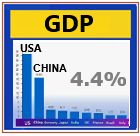
The U.S. economy expanded at a 2.5% pace in the first three months of 2013, up from 0.4% in the fourth quarter, as consumer spending rose at the fastest rate in two years and businesses restocked warehouse shelves. |
2.5% |
|
|
Growth |
Yet government spending fell sharply again ands imports surged to act as drags on economic growth, according to data released Friday by the Commerce Department. Economists surveyed by MarketWatch had forecast growth to rise to 3.2%, so the less-than-expected number could weigh on U.S. markets. |
|
|
Fri |
Consumer Sentiment |
The University of Michigan-Thomson Reuters consumer-sentiment gauge fell to a final April 2013 reading of 76.4 -- the lowest result since January 2013-- from a final March 2013 reading of 78.6. |
76.4 |
|
|
Consumer |
In April consumers faced negative news on jobs and federal spending, though they also saw stocks rise and gasoline prices decline. In addition, they've been hit by higher payroll taxes. |
|
|
|
|
|
|
|
|
|
|
|
|
|
|
|
|
|
|
|
|
|
|
|
|
|
| |
|
|
|
|
|
| |
|
|
|
|
|
|
|
|
|
|
| |
|
| WEEK 17-2013 ENDING APR. 26 |
Reports Commentary
The GDP is clearly in positive territory (in fact +3.1% is the expected reading for this Friday's report). And even with soft patches here and there it continues to expand at a reasonable enough rate to promote earnings growth.
When you combine that with the 10 year treasury paying a paltry 1.7%, then just the 2% dividend yield on the S&P 500 is reason enough to climb onboard stocks. Long story short, it's best to remain bullish until there are higher odds of a recession on the horizon. PMI Mfg Flash Index dropped to 52.0 versus 54.9.
Asian stocks closed lower led by a 2.57% decline in Shanghai, as China's Markit Flash PMI came up just short of expectations.
In Europe, Germany's Markit Flash PMI sank into contraction mode (i.e. a reading below 50) for the first time this year.
Consumer spending, which alone accounts for roughly two-thirds of GDP, rose at a 3.2% annual pace, the fastest pace since the end of 2010.
At first glance, that's pretty remarkable, since most workers saw their take-home pay drop in January, following the end of the payroll tax cut.
Meanwhile, cuts in government spending, mainly related to defense, dragged on the economy in the first quarte
The world's largest economies are losing momentum.
Recent data shows slowing growth in the United States and China, while Europe's recession is still underway. Japan has announced a massive stimulus program, but it's not likely to grow much this year either.
Job growth waned, the housing recovery lost some steam and consumers cut back on spending in March. New data released Tuesday shows American factories reporting their weakest growth in six months in April.
The government's across-the-board spending cuts have only just begun, and will total $85 billion through September. They're expected to prevent the U.S. economy from growing beyond 2% this year.
Across the Pacific, China's manufacturing sector also reported weaker growth. That disappointing news follows earlier reports showing that the broader Chinese economy grew at a slower pace in the first quarter.
Part of the problem there comes from weaker global trade. Whenever the U.S. and Europe are slow, the domino effect hurts Chinese exports. Chinese authorities have also been reluctant to stimulate their economy, amid concerns about rapid credit growth and fears of a property bubble.
The euro zone is still stuck in a recession. Even Germany, the largest of the European economies, saw its services and manufacturing sectors contract in April.
Japan is the exception to the other large economies, in that the country recently launched a large stimulus program known as "Abenomics," the brainchild of Prime Minister Shinzo Abe includes large public spending programs and easier monetary policy from Japan's central bank.
What do the Economic Reports reveal about the state of the economy?
- Boston Marathon Bombing aftermath: April 15, 2013
- GDP report shows U.S. economy growing 2.5% in first quarter.
- U.S. existing-home sales decline in March. U.S. new-home sales rise 1.5% in March
- U.S. consumer sentiment falls to three-month low.
|
|
| |
|
|
|
|
| |
|
To prepare for this week we have posted the following Blog: |
|
|
| |
|
Cyprus's debt Crisis |
|
|
| |
|
|
|
|
|
| |
|
|
|
|
IMPORTANT NOTE: In an effort to comply with all applicable rules, regulations and disclosures please be so kind and read the "General Disclosure" below: |
| |
|
|
|
|
|
|
| GENERAL DISCLOSURE - TRADINGVESTING.COM |
- The material contained on our Website and Economic Calendar must be used at your own risk. Material is believed to be reliable, but we do not guarantee its accuracy or validity, nor is Tradingvesting.com responsible for any errors or omissions which may occur. The analysis and/or recommendations made by Tradingvesting.com do not provide, imply, or otherwise constitute a guarantee of performance. All contents and recommendations are based on data and sources believed to be reliable, but accuracy and completeness cannot be guaranteed. It should not be assumed that future results will be profitable or will equal past performance, real, indicated or implied.Tradingvesting.com website and material contained therein is not a solicitation to participate in the Futures/Stocks/Options Market. This Economic Calendar does not include Earning Releases, Announced Stock Splits, Upcoming Initial Public Offerings with Underwritings or Rating Changes. Tradingvesting.com has attempted to verify the information contained in this calendar. However, any aspect of such info may change without notice. Unless indicated otherwise: economic data is from the U.S and intraday data is at least 20 minutes delayed; all prices are in the local currency; Time is U.S. Eastern Time. Furthermore, there is a very high degree of risk involved in trading.Tradingvesting.com assumes no responsibilities for your trading and investment results, please red our Risk Disclosure.
- Tradingvesting.com does not provide investment advice, and does not represent that any of the information or related analysis is accurate or complete at any time. All information on this website are for educational purposes only and are not intended to provide financial advice. Any statements about profits or income, expressed or implied, do not represent a guarantee. Your actual trading may result in losses as no trading system is guaranteed. You accept full responsibilities for your actions, trades, profit or loss, and agree to hold Tradingvesting.com and any authorized distributors of this information harmless in any and all ways. We respect your right to privacy, please click here to view our privacy policy.
- U.S. Government Required Disclaimer - Commodity Futures Trading Commission.
Futures and options trading has large potential rewards, but also large potential risk. You must be aware of the risks and be willing to accept them in order to invest in the futures and options markets. Don't trade with money you can't afford to lose. This website is neither a solicitation nor an offer to Buy/Sell futures or options. No representation is being made that any account will or is likely to achieve profits or losses similar to those discussed on this website. The past performance of any trading system or methodology is not necessarily indicative of future results.
- CFTC rule 4.41: Hypothetical or simulated performance results have certain limitations. Unlike an actual performance record, simulated results do not represent actual trading. Also, since the trades have not been executed, the results may have under-or-over compensated for the impact, if any, of certain market factors, such as lack of liquidity. Simulated trading programs in general are also subject to the fact that they are designed with the benefit of hindsight. No representation is being made that any account will or is likely to achieve profit or losses similar to those shown.
- Risk Warning: Trading foreign exchange on margin carries a high level of risk, and may not be suitable for all investors. The high degree of leverage can work against you as well as for you. Before deciding to invest in foreign exchange you should carefully consider your investment objectives, level of experience, and risk appetite. The possibility exists that you could sustain a loss of some or all of your initial investment and therefore you should not invest money that you cannot afford to lose. You should be aware of all the risks associated with foreign exchange trading, and seek advice from an independent financial advisor if you have any doubts. Our linking to these sites does not constitute an endorsement of any products, services or the information found on them. Once you link to another site you are subject to the policies of the new site. By using this site, you agree to the Terms of Service, Privacy Policy and Risk Disclosure. Copyright 2013 Tradingvesting, LLC. All rights reserved. If you have any questions regarding the Online Economic Calendar application, please contact us: click here.
THIS BRIEF STATEMENT CANNOT, OF COURSE, DISCLOSE ALL THE RISKS AND OTHER ASPECTS OF THE COMMODITY MARKETS AND EQUITY MARKETS. PLEASE READ MORE AT: TERMS OF SERVICE.
|
|
|
| |
|
|
|
|
|
| |
|
|
|
|
|