|
 |
|
|
|
Week 23 -2013 | From Jun. 03 to Jun. 07, 2013 |
|
 |
|
|
|
|
|
|
| |
|
|
|
|
|
|
|
|
|
|
| |
Economic Data for Week 23-2013 | Global View
| Week Rating
| DATE |
DAY |
REPORT/CATEGORY |
HIGHLIGHTS ON WEEK 23-2013 |
LAST |
|
Mon |
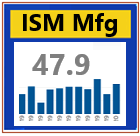
ISM Manufacturing Index |
U.S. manufacturers contracted in May 2013 for the first time since last fall. The Institute for Supply Management index fell to 49.0% last month from 50.7% in April 2013, marking the first contraction since November 2012 and the lowest reading since June 2009. |
49.0
Level
|
|
 |
Manufacturing |
New orders slipped and there was less demand for exports, a new industry report showed. The ISM's new-orders gauge dropped to 48.8% from 52.3%. The production index slid to 48.6% from 53.5%. And the employment gauge edged down to 50.1% from 50.2%. |
|
|
Mon |
Construction Spending |
U.S. Construction Spending rose slightly, but fell short of estimates. business spending pushed U.S. construction outlays slightly higher in April 2013, offsetting declines in projects at private homes and in the public sector. |
0.4%
M/M
|
|
|
Growth |
Construction spending rose 0.4% to an annual rate of $861 billion, a smaller gain than the 0.8% increase that was expected. |
|
|
Tue |
ICSC Goldman Sachs Index |
ICSC-Goldman Store sales burst higher last week, up 1.9% for year-on-year same-store growth of 4.3% which is the highest rate since May last year. The reason was a better demand going into the Memorial Day weekend. |
4.3%
Y/Y
|
|
|
Sales and Inventories |
ICSC Research anticipates comparable-store sales will increase by between 3% and 3.5% for the month of June 2013. |
|
|
Tue |
U.S. Trade Balance |
The Nation's international trade deficit in goods and services increased to $40.3 billion in April 2013 from $37.1 billion (revised) in March 2013, as imports increased more than exports. |
$-40.3
Billions |
|
|
Balance of Payments |
Goods and Services Deficit Increases in April 2013. More imports from China and a bigger inflow of petroleum has increased the trade gap. U.S. exports have also been soft because of a global economic slowdown. |
|
|
Tue |
Johnson Redbook |
Redbook's year-on-year same-store sales rate of plus 2.9% is up 2 tenths from the prior week and is slightly above the two-month trend. But Redbook's month-to-month call for May 2013 is very strong, at plus 0.6% in a reading that points to strength for the government's ex-auto ex-gas category. |
2.9%
Y/Y
|
|
|
Sales and Inventories |
Redbook doesn't show the burst of strength that ICSC-Goldman does for the June 1 week, but the report does show greater full-month strength than ICSC-Goldman. |
|
|
Wed |
MBA purchase Applications |
Interest rates on U.S. mortgages continued to surge last week, rising above 4% for the first time in a year and driving down demand from homeowners to refinance, data from an industry group showed on Wednesday. |
-11.5%
W/W
|
|
|
Real Estate |
Mortgage applications drop as rates surge. Demand for refinancing was hit hardest by the acceleration in rates, with applications slumping 15.0%. |
|
|
Wed |
ADP Employment Report |
Businesses added a disappointing 135,000 jobs in May, private payroll processor ADP said Wednesday, a sign that big federal budget cuts may finally be taking a toll on the labor market. |
135,000
Jobs
|
|
|
Employment |
Economists estimated that ADP would report 167,000 job gains. Ahead of the ADP report, they forecast that the Labor Department's more closely-watched employment report Friday would show an increase of 165,000 jobs, including the private sector and federal, state and local governments. |
|
|
Wed |
Productivity and Costs |
The productivity of U.S. workers rose in the first quarter as companies tried to contain labor costs. The measure of employee output per hour increased at a 0.5% annual rate, after a 1.7% drop in the prior three months, revised figures. |
0.5%
Q/Q
|
|
|
Business Actvity |
The drop in labor expenses in the first quarter was the biggest in four years and was revised from a 0.5% gain previously reported. It followed a revised 11.8% surge in the last three months of 2012 that was the biggest jump since the first quarter of 2000. |
|
|
Wed |
ISM Non-Mfg Index |
Economic activity in the non-manufacturing sector grew in May 2013 for the 41st consecutive month, say the nation's purchasing and supply executives in the latest Non-Manufacturing ISM Report On Business. |
53.7 |
|
|
Business Actvity |
The ISM's non-manufacturing index rose 6 tenths in May to 53.7. The Non-Manufacturing Business Activity Index registered 56.5%, which is 1.5% points higher than the 55% reported in April 2013, reflecting growth for the 46th consecutive month. |
|
|
Wed |
Factory Orders |
Factory orders rise less than expected in April 2013. New orders for factory goods rose in April 2013, but not enough to reverse the prior month's plunge, adding to signs of a slowdown in manufacturing activity. |
1.0% |
|
|
Manufacturing |
The Commerce Department on Wednesday said new orders for manufactured goods increased 1%. March's orders were revised to show a 4.7% decline instead of the previously reported 4.9% tumble. |
|
|
Wed |
EIA Crude Oil |
The U.S. Energy Information Administration (EIA) reported that US crude-oil supplies slipped 6.3 million barrels for the week ended May 31, to 391.3 million barrels. |
-6.3M
Barrels
|
|
|
Commodity |
Also, gasoline supplies retreated by 400,000 barrels, while distillate stockpiles climbed by 2.6 million barrels.
|
|
|
Wed |
Beige Book |
Overall economic activity increased at a modest to moderate pace since the previous report across all Federal Reserve Districts except the Dallas District, which reported strong economic growth. The manufacturing sector expanded in most Districts since the previous Beige Book. |
N/A |
|
|
Interest Rates |
The manufacturing sector expanded in most Districts since the previous Beige Book. Most Districts noted that consumer spending increased during the reporting period, ranging from slight to moderate gains. |
|
|
Thu |
Jobless/Initial Claims |
About 346,0000 people filed initial jobless claims last week, 11,000 fewer than a week earlier, the Department of Labor reported on week 23 ending june 7, 2013. |
346K |
|
|
Employment |
Fewer Americans filed first-time claims for unemployment benefits last week, pointing to more slow and choppy improvement in the job market. |
|
|
Thu |
EIA Natural Gas Report |
EIA Natural Gas Storage change 111 bcf from 88 bcf. Industry experts were looking for smaller build of between 93 bln to 97 bln cubic feet. |
111
bcf
|
|
|
Commodity |
Natural gas futures plunged this morning after a weekly inventory report found a 111-bln cubic feet rise in private-sector supplies last week to 2.25 trillion cubic feet, the U.S. Energy Information Agency said. |
|
|
Thu |
Fed Balance Sheet |
The Fed's balance sheet, which is a broad gauge of its lending to the financial system, stood at $3.357 trillion on June 5, compared to $3.342 trillion on May 29. |
$15.1B |
|
|
Government |
he U.S. Federal Reserve's balance sheet grew in the latest week on larger holdings of U.S. Treasuries, Fed data released on Thursday showed. |
|
|
Thu |
M2 Money Supply |
M2 Weekly Change $16.4 Billions from $-11.9 Billions revised to $-12.2 Billions. |
$16.4B |
|
|
Money Supply |
M2 included M1 and, in addition, short-term time deposits in banks and certain money market funds. In general, an increase in the supply of money typically lowers interest rates. |
|
|
Fri |
Fixed Mortgage Rates |
The 30-year fixed-rate mortgage averaged 3.91% in week 23 ending June 6, up from 3.81% the prior week, mortgage buyer Freddie Mac said Thursday. That's the fifth week in a row of gains, Freddie Mac said, and comes amid talk the Federal Reserve will slow the rate of bond purchases.
|
3.91% |
|
|
Interest Rates |
The 15-year fixed-rate mortgage rose above 3% for the first time in over a year, climbing to 3.03% from 2.98%. |
|
|
Fri |
Employment Situation |
Nonfarm payroll employment in April 2013 increased a somewhat improved 165,000 after rising a revised 138,000 in March 2013. Market expectations were for a 153,000 gain for April 2013. |
7.6% |
|
|
Employment |
The unemployment rate slipped to 7.5% from 7.6% in March 2013. Turning back to payroll data, private payrolls gained 176,000 after rising 154,000 in March2013. Wages improved after a lousy March 2013. Average hourly earnings rose 0.2%, following no change in March 2013. On the negative side, the average workweek edged down to 34.4 hours in April 2013 from 34.6 hours the month before. |
|
|
Fri |
Consumer Credit |
Consumer credit increased in April 2012 but a modest increase in a measure of credit card usage suggested households are still working on reducing their debt load, which could hobble consumer spending growth.
|
$11.1B |
|
|
Consumer |
Total consumer installment credit advanced by $11.1 billion to $2.8 trillion, Federal Reserve data showed on Friday. |
|
|
|
|
|
|
|
|
|
|
|
|
|
|
|
|
|
|
|
|
|
|
|
|
|
| |
|
|
|
|
|
| |
|
|
|
|
|
|
|
|
|
|
| |
|
| WEEK 23-2013 ENDING JUN. 23 |
Reports Commentary
Manufacturing
The Institute for Supply Management (ISM) said its index of national factory activity in May fell to 49.0 from 50.7 in April, short of expectations for 50.7.
Manufacturers in the U.S., China, and Europe struggled last month as demand fell, suggesting an ailing world economy that still needs a steady diet of central bank support.
Output at U.S. factories declined in May for the first time in six months, the Institute for Supply Management reported, while China's massive manufacturing sector shrank for the first time in seven months, adding to concerns that the world's two largest economies were losing momentum in the second quarter.
Euro zone manufacturing contracted again in May, its 22nd straight month of decline, though the depth of the downturn eased for the first time in four months.
Manufacturing has been hit by a combination of deep government spending cuts and slowing global demand, especially in China and the recession-hit Europe.
China Manufacturing Slows
In China, the HSBC China PMI showed total new orders and new export orders fell in May, highlighting weakness in both domestic and overseas demand. The index slipped to 49.2 last month, its worst performance since October.
Housing
With the Fed keeping borrowing rates low through its massive bond buying program, historically cheap mortgages have been one of the drivers of the recovery in the housing sector as the affordability lured in buyers.
But the recent rise in rates could test potential buyers' resolve. MBA's seasonally adjusted index of mortgage application activity, which includes both refinancing and home purchase demand, tumbled 11.5% last week.
Along with low interest rates, rising prices, a decrease in foreclosures and a tighter supply of available homes have all helped the housing sector get back on its feet.
FOMC
Fed chairman Ben Bernanke said last month the Fed could scale back the pace of its bond purchases at one of the "next few meetings" if the economic recovery looked set to maintain forward momentum.
The Fed is currently buying $85 billion a month in bonds and mortgage-backed securities. Along with some improving economic data, the comments sowed concerns among investors that the Fed's ultra-loose policy could end sooner than expected.
Beige Book
Instead, the so-called Beige Book released by the Fed, covering the period from early April to late May, said the economy maintained the modest to moderate pace that has been in place so far this year.
The Beige Book data, with the report of steady, if not spectacular growth, may be one reason that Fed Chief Ben Bernanke has suggested the central bank could reduce the pace of its bond-buying program in a few meetings, subject to the economic data.
Stocks are the Best Investment Alternative
When bond rates start to go up they will still be low and not attractive for the yield alone. Even worse, the value of bonds will decrease as the rates move higher. As investors see their bond funds drop in value for the first time in 30+ years, they will rotate more money towards stocks.
Also as Treasury rates move higher, so too will mortgage rates. This will make the cost of housing more expensive. And put a damper on real estate investments.
With no real inflation to speak of, then gold and silver will have no luster. And cash will still be trash.
Europe
The European Central Bank kept its main lending rate at a record low 0.5% at the conclusion of its meeting on Thursday. Last month, the ECB cut that rate by a quarter point from 0.75%.
The ECB left its deposit rate, which it pays banks on reserves held at the central bank, at zero. ECB President Mario Draghi will hold a press conference that begins at 8:30 a.m. Eastern Time.
What do the Economic Reports reveal about the state of the economy?
- Fed's Beige Book says economy on moderate path.
- U.S. Construction Spending rose slightly.
- U.S. manufacturers contracted in May 2013 for the first time since last fall.
- Productivity in U.S. Rises as Companies Try to Lower Labor Costs.
- Goods and Services Deficit Increases in April 2013.
|
|
| |
|
|
|
|
| |
|
To prepare for this week we have posted the following Blog: |
|
|
| |
|
Why did utilities sell off in May? |
|
|
| |
|
|
|
|
|
| |
|
|
|
|
IMPORTANT NOTE: In an effort to comply with all applicable rules, regulations and disclosures please be so kind and read the "General Disclosure" below: |
| |
|
|
|
|
|
|
| GENERAL DISCLOSURE - TRADINGVESTING.COM |
- The material contained on our Website and Economic Calendar must be used at your own risk. Material is believed to be reliable, but we do not guarantee its accuracy or validity, nor is Tradingvesting.com responsible for any errors or omissions which may occur. The analysis and/or recommendations made by Tradingvesting.com do not provide, imply, or otherwise constitute a guarantee of performance. All contents and recommendations are based on data and sources believed to be reliable, but accuracy and completeness cannot be guaranteed. It should not be assumed that future results will be profitable or will equal past performance, real, indicated or implied.Tradingvesting.com website and material contained therein is not a solicitation to participate in the Futures/Stocks/Options Market. This Economic Calendar does not include Earning Releases, Announced Stock Splits, Upcoming Initial Public Offerings with Underwritings or Rating Changes. Tradingvesting.com has attempted to verify the information contained in this calendar. However, any aspect of such info may change without notice. Unless indicated otherwise: economic data is from the U.S and intraday data is at least 20 minutes delayed; all prices are in the local currency; Time is U.S. Eastern Time. Furthermore, there is a very high degree of risk involved in trading.Tradingvesting.com assumes no responsibilities for your trading and investment results, please red our Risk Disclosure.
- Tradingvesting.com does not provide investment advice, and does not represent that any of the information or related analysis is accurate or complete at any time. All information on this website are for educational purposes only and are not intended to provide financial advice. Any statements about profits or income, expressed or implied, do not represent a guarantee. Your actual trading may result in losses as no trading system is guaranteed. You accept full responsibilities for your actions, trades, profit or loss, and agree to hold Tradingvesting.com and any authorized distributors of this information harmless in any and all ways. We respect your right to privacy, please click here to view our privacy policy.
- U.S. Government Required Disclaimer - Commodity Futures Trading Commission.
Futures and options trading has large potential rewards, but also large potential risk. You must be aware of the risks and be willing to accept them in order to invest in the futures and options markets. Don't trade with money you can't afford to lose. This website is neither a solicitation nor an offer to Buy/Sell futures or options. No representation is being made that any account will or is likely to achieve profits or losses similar to those discussed on this website. The past performance of any trading system or methodology is not necessarily indicative of future results.
- CFTC rule 4.41: Hypothetical or simulated performance results have certain limitations. Unlike an actual performance record, simulated results do not represent actual trading. Also, since the trades have not been executed, the results may have under-or-over compensated for the impact, if any, of certain market factors, such as lack of liquidity. Simulated trading programs in general are also subject to the fact that they are designed with the benefit of hindsight. No representation is being made that any account will or is likely to achieve profit or losses similar to those shown.
- Risk Warning: Trading foreign exchange on margin carries a high level of risk, and may not be suitable for all investors. The high degree of leverage can work against you as well as for you. Before deciding to invest in foreign exchange you should carefully consider your investment objectives, level of experience, and risk appetite. The possibility exists that you could sustain a loss of some or all of your initial investment and therefore you should not invest money that you cannot afford to lose. You should be aware of all the risks associated with foreign exchange trading, and seek advice from an independent financial advisor if you have any doubts. Our linking to these sites does not constitute an endorsement of any products, services or the information found on them. Once you link to another site you are subject to the policies of the new site. By using this site, you agree to the Terms of Service, Privacy Policy and Risk Disclosure. Copyright 2013 Tradingvesting, LLC. All rights reserved. If you have any questions regarding the Online Economic Calendar application, please contact us: click here.
THIS BRIEF STATEMENT CANNOT, OF COURSE, DISCLOSE ALL THE RISKS AND OTHER ASPECTS OF THE COMMODITY MARKETS AND EQUITY MARKETS. PLEASE READ MORE AT: TERMS OF SERVICE.
|
|
|
| |
|
|
|
|
|
| |
|
|
|
|
|