What is Quadruple Witching?
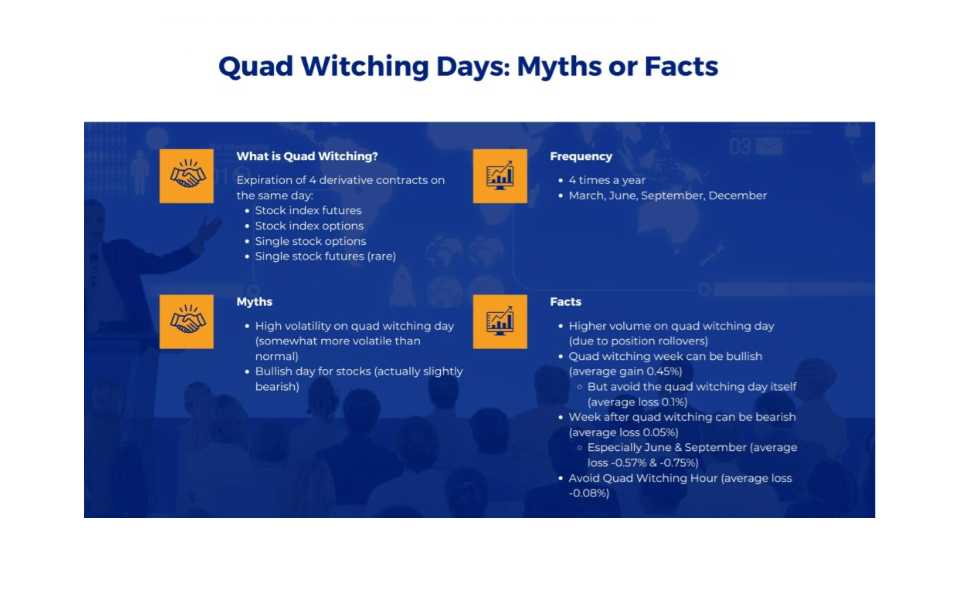
Quadruple witching is an event in financial markets when four different sets of futures and options expire on the same day. Futures and options are derivatives, linked to underlying stock prices. When derivatives expire, traders must close or adjust positions. That can trigger significant volume and order flow. The four types of derivatives expiring on quadruple witching are:
- Stock index futures contracts
- Single-stock options
- Options on stock-index futures
- Stock index options
Note: Some lists include single-stock futures on the list of quad-witching expirations. However these are relatively small products with minimal impact on the market.
Market Impact of Quadruple Witching
The simultaneous expiration of stock-index futures, options on stock-index futures, single-stock options and index options can generate significant volatility and volume. For example, the March 19, 2021, quad witching day saw the most volume in the S&P 500 all of last year. The other quad witching days also had above-average activity.
The folkloric name “witching” comes from the idea of certain times when dark, supernatural forces are active. It can metaphorically apply in markets if traders are forced to unwind large derivative positions. Such events could sometimes cause unexpected moves, although newer rules have reduced much of the previous havoc. For the most part, it now causes heavy volume.
Quadruple Witching?
Every third Friday in March, June, September, and December, Stock Exchanges record a strong increase in trading during a specific time, which can sometimes cause “strange” movements in asset prices. This is what is known as the quadruple witching hour, and it is the moment when, simultaneously, the quarterly expiration of futures and options on indices and stocks occurs. The etymological origin of this concept lies in British literature, specifically William Shakespeare. The term “witching hour” is considered to have originated from the three witches in Macbeth because there are strange movements in the market in a short time, as if they were spells.
Futures Opotions - Quadruple Witching
A future is a contract with which an agreement is reached to exchange an asset on a future date at a previously agreed price. The “expiration” of this contract is when the seller of the future must sell the underlying asset to the buyer of the future at the agreed price. An option is certainly more complex. While in the futures contract the parties have the obligation to execute the operation at the time of expiration, with an option the buyer has the “right” to decide whether or not the operation is closed. Let's give an example: an investor thinks that share X, which is now 28 euros, can rise in the next three months. To benefit from this increase, the investor decides to buy a call option that expires in three months, which will give them the right to purchase that share in three months. To do so, they pay a premium to the seller of the call option. Let's say that premium is quoted at 3 euros. If at the time that this option expires, the share price is more than 31 euros (28 + 3), the buyer of the option will exercise their right to purchase.
What Happens during Quadruple Witching hour
The quadruple witching hour is the last sixty minutes of the trading day on the third Friday of March, June, September, and December when contracts for stock index futures, stock index options, stock options, and single stock futures expire simultaneously. The last hour of those trading days is known as the “quadruple witching hour”, when many derivatives contracts expire, often creating volatility in the markets. That’s because there may be higher market volume on those days as traders either close out or roll over their positions.
Every third Friday in March, June, September, and December marks the simultaneous expiration of futures and options on indices and stocks. If this moment is known as the quadruple witching hour, is because the expiration of contracts has historically affected the price of underlying assets (indices and stocks). So much so that it seemed like the market was “enchanted.” But why can this expiration simultaneously affect the price of the underlying assets? To meet the delivery obligations of futures contracts and stocks, the underlying asset must be available. Many investors wait until the last moment to check the market status, so many operations usually occur on the same day the contract expires. This inevitably leads to an increase in trading volume. Historically ,this increased trading volume resulted in higher volatility. However, there is no causal relationship between these two phenomena. In summary: quadruple witching hour typically accompanies an increase in trading volume but not always in volatility. This is the case for several reasons. In Spain, the derivatives market not only has quarterly expirations, but also monthly ones, which spreads out the trading activity.
When does the quadruple witching hour take place? - Quad
As we have already mentioned, the simultaneous expiration of futures and options on indices and stocks takes place every third Friday of March, June, September, and December. However, it is not until a specific time on those days when the expiration of those contracts takes place. In each market it is usually done at a different time. It should also be noted that not all markets have a quadruple witching hour. In the United States, for example, it is only a triple witching hour, since in this market there are no futures on stocks. Although experts agree that nowadays extreme volatility is not common on quadruple witching days, investors should be prepared for a possible sharp movement in the financial markets. In conclusion, the quadruple witching hour can generate strong volatility in the market and, therefore, represents a risky moment for investors. Only those who are professionals and willing to take very high risks should operate in these high-uncertainty environments.
Important Points
• Quadruple witching involves the simultaneous expiration of four types of investment contracts, leading to increased market volatility on specific trading days
.
• This phenomenon occurs on the third Friday of March, June, September, and December, with heightened activity in the final trading hour.
• The four contracts involved are stock options, stock index futures, index options, and stock futures, all of which are derivatives tied to underlying assets.
• Increased trading volume on quadruple witching days can result in significant price swings and influence the market dynamics, especially among active traders.
• While quadruple witching may not impact long-term investment strategies, it presents short-term opportunities for experienced investors seeking to capitalize on market volatility.
|