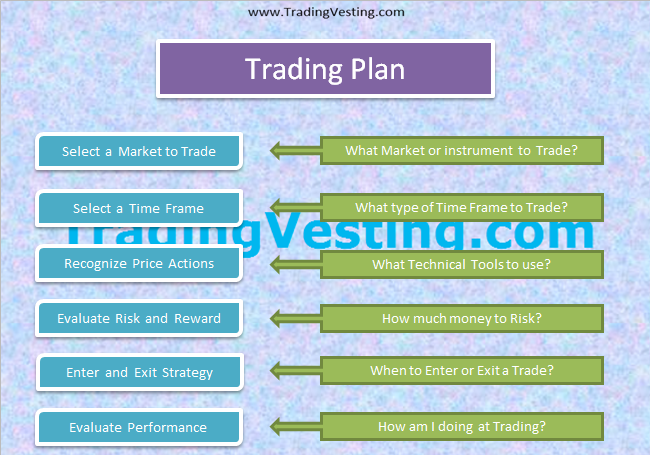
Our Trading Plan covers each of the decisions required for successful Market Traders by providing answers to every questions that a Trader encounters.
We have divided Trading in 3 major categories:
- Trading Plan
- Money Managment
- Technical tools
Tradingvesting GamePlan must include the following:
- Entry Breakout
- Exit Scenarios
- Position Sizing
- Tactics
- Performance
Tradingvesting Money Management should answers the following questions:
- What to trade?
- How much to Trade?
Tradingvesting Technical Tools should answer the following:
- How to trade?
- What Tool I use to Trade?
Technical Analysis
Technical analysts traders often look at volume to gauge changes in supply and demand for a stock. In this case, because the heavy trading is occurring as Apple is falling, it may be signaling a mass, ongoing liquidation as the year comes to a close.
Technical analysts follow spikes in volume because they often signal panic selling or panic buying. History shows that they often mark major turning points for stocks.
Investing Mistakes
Everybody makes mistakes. The difference between success and failure is how you deal with those mistakes. Nowhere is this more prevalent than in investing.
1. Waiting to Get Even
It is common for investors to buy a stock that declines in value and then, regardless of underlying fundamentals, hold the stock until it at least gets back to the price they bought it for. Many people hate the idea of selling a stock at a loss, so they may hold on to a particular stock too long while other opportunities pass them by. Behavioral finance describes this as a cognitive error. By failing to sell certain stocks, investors can lose in two ways. First, they can hold onto the stock as it continues to decline in value and possibly ends up worthless. Second, there is an opportunity cost, where the stock could have been sold and proceeds reinvested in a stock with more upside that make up the value lost in a more timely matter.
Getting your portfolio back to where it once was can be difficult, especially if you are hanging onto losers because you cannot stand to sell at a loss. If your portfolio falls 30%, you need to go up 43% to get back to even. A decline of 50% requires an increase of 100% to get back to even. Too many people believe if a stock drops 20%, they just need a rise of 20%, but basic math proves otherwise.
This is not true in every case. Some stocks can decline in price and make a quick rebound, but stock fundamentals cannot be ignored. The same mistake can be made with mutual funds, ETFs and bonds.
What's the best interval for day trading charts?
Don't use intervals of ANY minutes
2. Market Timing
Being able to time the market consistently and accurately is the holy grail of investing. No one, in the history of the stock market, has been able to do this. Timing the market means being able to forecast dips, corrections and bear markets and move assets out of stocks as these events occur. But that is only half the battle, as you have to forecast when to get back in as well. That is two decisions that you would need to get exactly right. The reality is most investors who attempt this end up getting whipsawed, meaning they sell too late and get back in the market too late. In other words, they capture all the downside and miss the upside. Small declines, and full-blown 10% corrections, are impossible to time because they are just normal market movements and happen based on emotions and fear, two things that cannot be forecasted.
3. Becoming Emotionally
People invest to make money. Whether it's capital appreciation or income, investors choose to take some level of risk in exchange for increasing the value of their portfolio or attaining some income. Yet many investors become emotionally tied to a stock either because they work at the company or the stock has given them exceptional returns.
For example, many investors got caught up in the Apple hype and bought the stock when it was near $700. Even the death of the iconic CEO, Steve Jobs, didn't deter people's enthusiasm for the stock. The iPhone was responsible for a large part of Apple's success, but investors to a large degree ignored increasing competition from Google's Android because they loved Apple. As Apple lost market share to competitors who have caught up with the smartphone innovation that Apple once dominated, the stock price correspondingly fell.
Another example is Enron. In this case, employees had a large portion of their wealth tied up in Enron stock. An outside observer may have noticed the unusual amount of volatility the stock was experiencing, but the warning signs went ignored as the price rose. Eventually, an accounting scandal took the company down along with many retirement accounts.
Mistakes and Missteps
Making mistakes is part of investing. You just need to be right more often than you are wrong. When you do make a mistake, don't compound the problem and make it worse. Be cognizant of these common mistakes when making decisions and it will likely benefit you in the long run.
|