Reports Commentary
If economic data come in strong, the market may build on expectations that the Fed will accelerate the wind-down of its stimulus program, while positive employment data may move forward expectations of rate hikes.
After the market surged to a new high to end 2013, it now needs time to digest those gains. As such profits are being taken from some of the recent darlings and rotated to new positions.
A lot of this activity is driven by a desire to take profits on big winners, yet delay the tax consequences. Meaning profits on a stock sold on December 31st are due to Uncle Sam by April 2014. Whereas just waiting another couple days for the calendar to flip to the new year allows an investor to keep that extra money around until April 2015.
China PMI
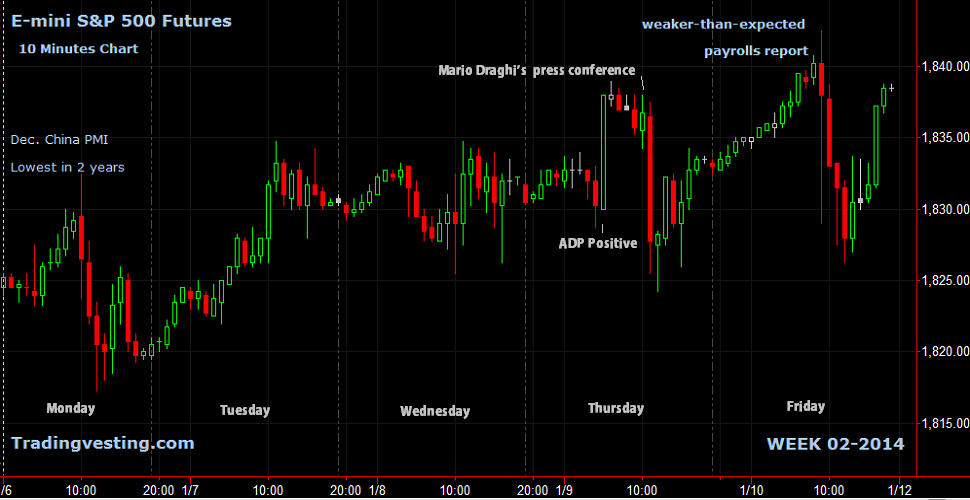
China December HSBC services PMI falls to lowest in over 2 years. Growth in China's services sector slowed sharply in December to its lowest point since August 2011, a private sector survey showed on Monday, adding to signs of slowing momentum in the world's second-largest economy.
The HSBC/Markit services sector Purchasing Managers' Index (PMI) dropped to 50.9 in December from 52.5 in November, with new business expansion the slowest in six months.
In China, trade, inflation and loans data due later in the week will color regional sentiment. Two surveys last week showed manufacturing activity has weakened in December, which analysts said pointed to a downturn in business cycle.
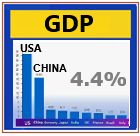
China's economic growth is likely to come in at 7.6% in 2013, the government has said, just above the official target of 7.5% and slightly below the 7.7% in 2012.
Gold mini Flash Crash on Monday
Gold futures plunged more than $30 at 10:14 a.m. EST on Monday morning, before regaining nearly all of that drop within the same minute.
The swift move triggered a 10-second pause in trading, and many market participants said a single trading error was probably to blame.
Bond Market
Treasurys rallied Monday after weak data on the U.S. services sector, sending the 10-year yield further below 3% to kick off a week full of market-moving events.
The benchmark yield closed 2013 above 3%, but has ended all sessions since below that key psychological level.
Non-manufacturing index
The Institute for Supply Management's non-manufacturing index came in at 53.0 in December, versus estimates that the index would climb to 54.6 from 53.9 the month before.
While under forecasts, the index still came in "well above the 50-line of demarcation," said Stone of the level that separates expansion from contraction. The services report was also offset by "better-than-expected factory orders, which is the real deal, although more dated," said Stone, referring to separate data from the Commerce Department, which reported new orders for U.S. factory goods rebounded in November, increasing 1.8%.
Employment
The ADP Employment report on Wednesday was a smashing success. There we see new jobs added being 15% above already robust expectations. Plus November results were revised amply higher
What are investors waiting for?
a) Confirmation from the Government's Employment Situation report on Friday
b) Q4 earnings season results
c) Government debt limit debate finale
Job creation stumbled in December, with the economy adding just 74,000 positions even as the Federal Reserve voted to take the first steps in eliminating its stimulus program.
The unemployment rate dropped to 6.7 percent, below economist estimates and due primarily to continued shrinkage in the labor force. The labor force participation rate tumbled to 62.8 percent, its worst level since January 1978.
What do the Economic Reports reveal about the state of the economy?
In 2013, the Federal Reserve — with constant hints of a retreat from quantitative easing — created a series of 3% to 7% corrections. The bulls expect recent clarity on tapering in the Fed's bond-buying program to help the market. The market can price bad news but it struggles with uncertainty.
Since early 2009, the Fed's expanding balance sheet and the S&P 500 have marched higher together.
The incoming Fed chief Janet Yellen probably won't stray much from Ben Bernanke's approach. However, she might run a tighter ship than Bernanke did.
Some market watchers believe the Fed's low-interest rate policy wasn't so much about stimulus as it was about giving Washington a chance to fix the budget deficit and national debt problems. If rates rise, servicing the debt will put a huge dent in the federal government's budget. Thus low rates bought Washington time.
|