Risk
Investment risk tolerance is known by many different names, but it's all the same thing. Some of the other names are: Investor risk tolerance, risk temperament, risk profile, investment profile, investor profile, investment profiler, investor profiler, risk attitudes, and investing risk tolerance.
Investment risk tolerance is used in most of the CFA readings, so we're sticking with thatBecause none of this is an exact science, most investment managers work with three to seven risk categories. We use five because we feel three isn't enough and seven is too many.These five categories are summaries of how the investor feels about investment risk, how much downside market fluctuations can be tolerated, and how much they expect to profit when markets are going up.The biggest reason for needing to classify someone into a defined category, is because most investment advisors use asset allocation models that correspond directly with each category. This is exactly what we do with our portfolio models. Once one is put into a category, an investment adviser can easily invest their money appropriately by using the corresponding model portfolio.Establishing investment goals and risk tolerance is the most critical aspect of implementing a successful investment portfolio strategy.
Ask yourself whether you are saving for retirement, or for a specific purpose, like your kid's college education.
Do you need to set aside cash to buy a home at some point?
Do you need a regular income from the investment?
All of this will impact on your portfolio management so take the time to carefully assess your needs - both in the short term and the long term.
With an initial understanding of your objectives, and capacity & tolerance for risk, you can start to build a framework for your portfolio management.
This often involves deciding upon a target asset allocation for your portfolio - the practice of spreading or diversifying your assets amongst various asset classes such as stocks and bonds.
This is an important step in spreading your risk and achieving your investment goals.
AGE
In setting your investment goals, your age is a very important factor. The age of an investor is usually positively correlated (moves in a positive or same direction) with the type of investments they will commit to. This means that as you get closer to your retirement, you will typically move away from investments that have a high degree of risk, require a large amount of capital (money) or have low liquidity (ability to convert the investment easily into cash).
Conversely, if you are at a young age you have a longer investment horizon (time available to invest) available to you and therefore can choose to take higher levels of risk, provide more capital (money) for your investments and not be as concerned about the investment liquidity because you are able to continue to gain wealth, because of your age, even if your investment has not returned what you wanted it to.
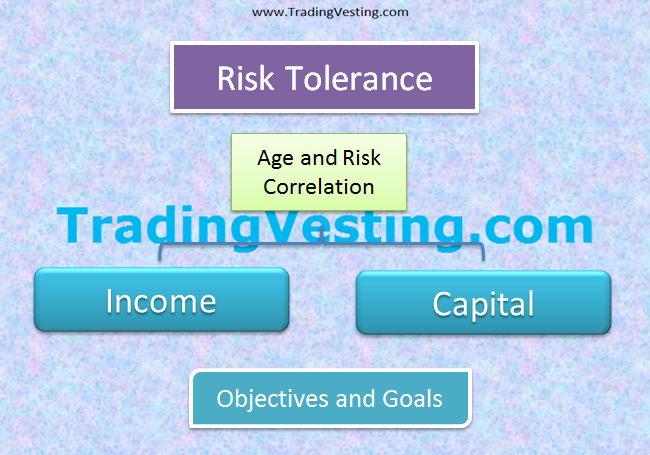
The Age and Risk Correlation
While these two different situations may not always be true, most people will not choose to adopt a lot of risk at an older age because they have spent the majority of their life earning money, and choose not to take unnecessary risks later in life that may lose them their earnings. Young people don’t have this concern as they have a longer time horizon in which to re-invest should an investment turn sour. Therefore, it is important to understand that this means that age is positively correlated to the amount of risk that will be adopted (see Risk Section) and it is sensible to parallel this relationship to your own investment strategy. |